 |
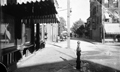
Harvard Square, 1898
Standing in Harvard Square looking at Kent St. From left to right:
- 11 Harvard Sq., Frank F. Seamens, Groceries. Note dated poster in the window.
- Man and unusual wagon on Kent St.
- #9 Harvard Sq., C. A. Delano, Dry Goods
(ID) 143
(Slide ID) P-7-1
[Source: William Robert Murphy Collection]
|
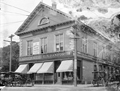 |
Harvard Square, Brookline Village, August 11, 1903
This photo shows the final stage of the full building at 11-13 Harvard Square. On the left, with its delivery wagons parked out front, is T. H. Dyer, Provisions. On the right, at #13 Harvard Sq., is Frank F. Seamens, Groceries recently renamed to L. N. Danforth. It appears that Lucius N. Danforth, a clerk at the Dyer store for two decades and at the George Joyce store there before that, has recently taken over the Seamens store. But the Danforth store will be short-lived. The town had that side of the building removed to allow for the widening of Harvard St. and a new building would replace it in two years.
(ID) 141
(Slide ID) P-14-8
[Source: William Robert Murphy Collection]
|
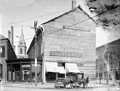 |
Harvard Square, circa 1905
This is a rare photo of the Harvard Hall building just prior to its replacement after a battle with the town and the invocation of eminent domain. The town needed to widen both Washington St. and Harvard St. and was literally shaving off sections of the building which sat at the apex of the two streets. The grocer, T. H. Dyer, insisted on remaining open and the building owner, in litigation with the town, covered the reduced and now-asymmetrical building with makeshift boarding.
(ID) 140
(Slide ID) P-14-12
[Source: William Robert Murphy Collection]
|
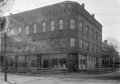 |
Harvard St. at School St.
Standing on Aspinwall Ave. School St. is on the right with the houses at 16/18 School St. and 2 Prospect St. and the Pierce Grammar School are visible. Harvard Hall at 6 School St. was a large area upstairs used for parties and meetings. The stores, numbered 82-90, are on the west side of Harvard St. The only identifiable one is William Sundell, Painting & Glazing, 84 Harvard St.
(ID) 139
(Slide ID) P-8-8
[Source: William Robert Murphy Collection]
|
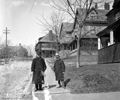 |
Allerton St.
Looking at the north side of Allerton St. Note the surveyor’s stick lying on the ground – the two men are presumably from the town engineering department. From left to right:
- 14 Allerton St. across High St.
- 28 Allerton St.
- 32 Allerton St.
- 36 Allerton St.
- 44 Allerton St.
(ID) 138
(Slide ID) P-1-1
[Source: William Robert Murphy Collection]
|
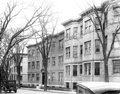 |
Dwight St., 1933
Looking east from Babcock St.
(ID) 136
(Slide ID) P-195-199
[Source: William Robert Murphy Collection]
|
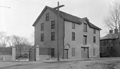 |
Brookline Waterworks, Pearl St.
This location was the pipe yard for the water department for many years. The rear of the Winthrop School building on Brookline Ave. is to the right.
(ID) 132
(Slide ID) P-24-17
[Source: William Robert Murphy Collection]
|
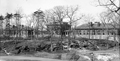 |
Contagious Hospital, Newton St.
These two hospital buildings and the administration building in the middle were constructed in 1902 on the hill above the Putterham School to isolate and treat the rising number of cases of diphtheria and scarlet fever.
[ref. The Chronicle, October 25th, 1902]
(ID) 127
(Slide ID) P-24-11
[Source: William Robert Murphy Collection]
|
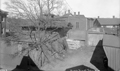 |
Park Department Stables, Pierce St.
On the right is the rear of a house set back from Harvard St. across from St. Mary's church.
(ID) 126
(Slide ID) P-24-9
[Source: William Robert Murphy Collection]
|
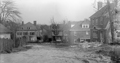 |
Unidentified, April 30, 1927
Possibly in the Aspinwall Hill area
(ID) 124
(Slide ID) P-9-22
[Source: William Robert Murphy Collection]
|
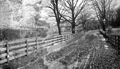 |
Reservoir Rd., 1903
Looking sorth as the road approaches Boylston St. From left to right:
- Foreground left: the land of Ebenezer Warren Reed that will soon become the site of the Heath School
- 39 Eliot Crescent, on the far left; a three-story apartment building built in 1901, still standing
- Houses on Duffy Court, Eliot Crescent, and Boylston St.
- At the end of Reservoir Road at the corner of Boylston Street – the house of Ebenezer Warren Reed
(ID) 123
(Slide ID) P-9-2
[Source: William Robert Murphy Collection]
|
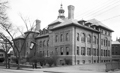 |
Pierce Grammar School, School St.
Opened in 1901 as a replacement for the much smaller school located behind it on Prospect St. No longer standing.
(ID) 122
(Slide ID) P-25-18
[Source: William Robert Murphy Collection]
|
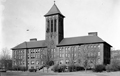 |
High School
(ID) 121
(Slide ID) P-25-18
[Source: William Robert Murphy Collection]
|
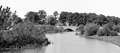 |
Netherlands Rd. Bridge Over the Muddy River
Looking northwest across Netherlands Rd. at the garage and rear of the house at 203 Kent St.
(ID) 120
(Slide ID) P-28-2
[Source: William Robert Murphy Collection]
|
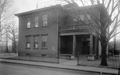 |
Longwood School, St. Mary's St.
This is the only known photo of the school. Note that this is a different school than the Longwood Day School on Browne St.
(ID) 119
(Slide ID) P-25-11
[Source: William Robert Murphy Collection]
|
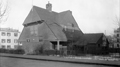 |
Parsons School, Walter Ave.
This is the only known photo of the school.
(ID) 117
(Slide ID) ?
[Source: William Robert Murphy Collection]
|
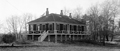 |
Board of Health Hospital, Newton St.
(ID) 116
(Slide ID) P-24-5
[Source: William Robert Murphy Collection]
|
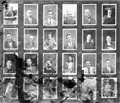 |
Portrait Photos, Town Engineering Dept., 1924
(ID) 114
(Slide ID) ?
[Source: William Robert Murphy Collection]
|
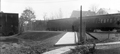 |
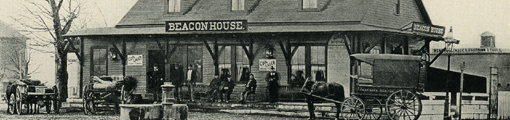
Beaconsfield Train Station; October 31, 1917
Standing by the garage for the Beaconsfield Terraces complex looking south at 311 and 317 Clark Rd.
(ID) 112
(Slide ID) ?
[Source: William Robert Murphy Collection]
|
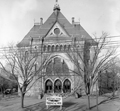 |
Town Hall, 1919
(ID) 109
(Slide ID) P-24-1
[Source: William Robert Murphy Collection]
|

 The Society
 Program Archives