|
The Society
Historical Information
Photo & Map Collections
Exploring Brookline
Links
Program Archives
|
Photo Collection
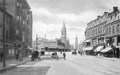 |
Harvard Square, Brookline Village, 1907
The Harvard Hall building has been replaced with the building that still stands today.
|
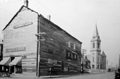 |
Harvard Hall, 1905
This is a rare photo of the Harvard Hall building just prior to its replacement after a battle with the town and the invocation of eminent domain. The town needed to widen both Washington St. and Harvard St. and was literally shaving off sections of the building which sat at the apex of the two streets. The grocer, T. H. Dyer, insisted on remaining open and the building owner, in litigation with the town, covered the reduced and now-asymmetrical building with makeshift boarding.
[Source: Historic New England]
|
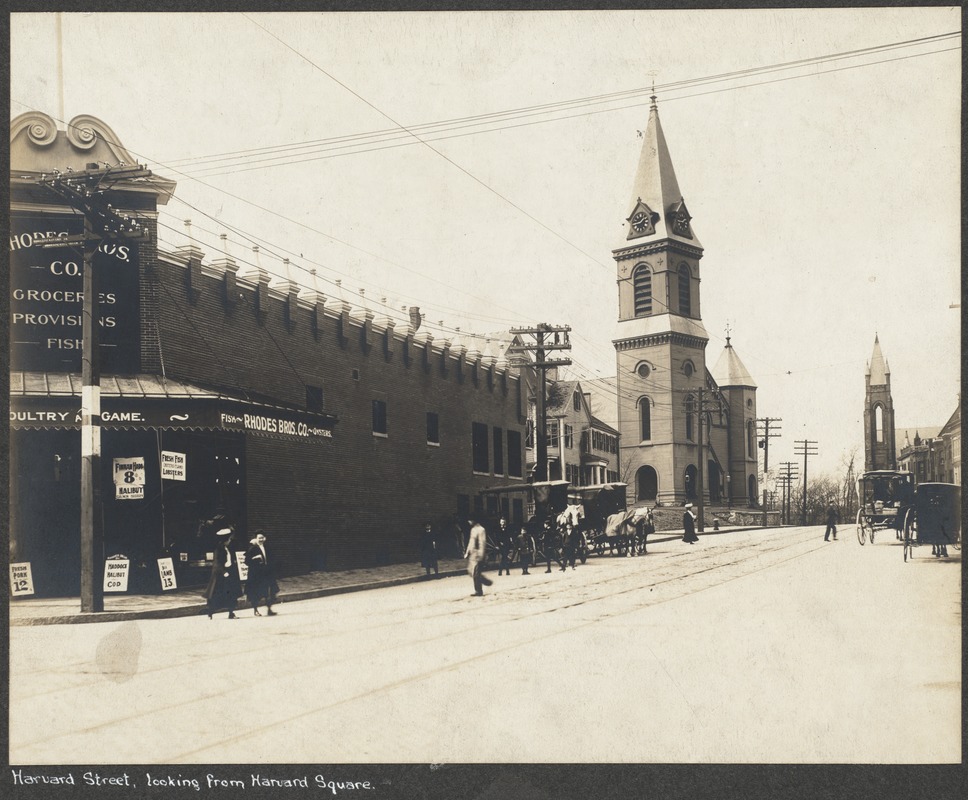 |
Harvard Square, April 11, 1906
Looking north on Harvard St. from Harvard Square. Rhodes Bros., Groceries and Provisions, which opened at the very end of 1905. This building, which still stands today, replaced the Harvard Hall Building which, following a contentious struggle with the town, was taken down after being downsized to accommodate the widening of Harvard St. Rhodes Bros. remained there until World War II.
[Source: Digital Commonwealth]
|
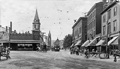 |
Harvard Square, Brookline Village, Circa 1908
The majority of the structures in this photo are still standing. From left to right:
- Rhodes Bros., Groceries and Provisions, which opened at the very end of 1905. This building, which still stands today, replaced the Harvard Hall Building which, following a contentious struggle with the town, was taken down after being downsized to accommodate the widening of Harvard St. Rhodes Bros. remained there until World War II.
- Cast-iron watering stand for horses, with a lower rim for dogs, manufactured by Henry F. Jenks. More information
- The horse of the cheese-delivery wagon drinking from the fountain.
- The steeple of the Baptist Church, later the First Presbyterian Church, directly behind Rhodes Bros. It burned on New Year's Eve 1960-61
- The steeple of St. Mary’s church
- Woman exiting and woman entering the trolley car
- The National Bank building
- The Woman's Exchange, the one-story building at 5 Harvard Sq. Woman's Exchanges were part of a movement that enabled impoverished women to sell their wares in consignment stores whose organizations were run by women.
- The doorway at #2 Harvard Sq. leading to a rooming house called Somerset House. The sign announces Board and Room By Day or Week, Single Meals
- James Rooney Boots & Shoes at #1 Harvard Sq.
[Source: Joel Shield]
|
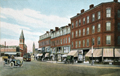 |
Harvard Square, Brookline Village, 1910s
Looking north from Washington St.
|
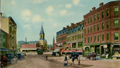 |
Harvard Square, Brookline Village, Boylston St. Trolley, 1910
Looking north from Washington St.
|
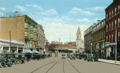 |
Harvard Square, Brookline Village, 1929
Looking north from Washington St.
|
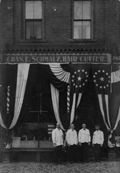 |
Charles E. Schmalz, Haircutter, circa 1901
238 Washington St., Brookline Village, the southwest corner of Davis Ave. The St. Andrew Building, still standing, remains virtually unchanged today. Traceable names of those working at the shop in 1901 are hairdressers Charles E. Schmalz, Adolf Koffinke, William Pebler, William Pickering, and John J. Moloney and boot black Samuel Short.
Charles Schmalz had a remarkably long working life in Brookline and maintained his business at 238 Washington for over fifty years. Here is his Brookline timeline:
- [1883-1896] By the age of 18, and possibly several years before that, he begins work at the barbershop of Peter Keiser at 157 Washington St., situated roughly at the western edge of today's Hearthstone Plaza. He lives upstairs above the shop until 1887. It appears that Keiser is his uncle.
- [1895] Runs the shop at 157 Washington St. Peter Keiser remains the owner but no longer works there.
- [1897] Opens his own shop at 238 Washington St. Peter Keiser returns to his old business.
- [1897-1949] Continues to maintain his business at 238 Washington St., apparently working there into the 1940s when he would have been in his seventies
- [1954] Dies at the age of 88
[Source: Joel Shield]
|
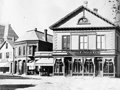 |
Panter's Building; Brookline Village, circa 1876
Looking North from Washington St. Panter's Building was a remodeling of the old Baptist church building at that site. It was obtained by John Panter as payment for his work on the replacement church, seen behind it, and converted into a commerical building. He later sold it to George Joyce who moved his grocery store from the Colonnade Building circa 1874.
[Source: Brookline Public Library]
|
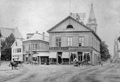 |
Panter's Building; Brookline Village, circa 1883
Washington St. continuing to the left, Harvard St. to the right. Note horse drinking water in front of the store. From left to right:
- The roof of town hall is visible
- Unidentified white house
- The store with the sign for A. B. Tyrrell, Upholstery. No longer listed in 1883
- The one-story building of Thompson Upholstery
- The new store of Thomas H. Dyer, grocer. Dyer, a Brookline resident, had previously co-owned a store across the street, Collins and Dyer, until 1877/78 when it became the store of Henry Collins & Co., Provisions. He then worked at the provisions store of Hartwell & Skinner in Boston's New Faneuil Hall Market. He is first listed here in the 1883 directory and would occupy the left side of the Panter’s building until 1904, when the building was replaced.
- The Joyce grocery store, which had originally occupied both sides of the Panter’s building. By 1883, Joyce had downsized to the right side only, seen here, and he was gone entirely by 1885. Frank F. Seamens, Groceries, would replace Joyce circa 1885 and also remain until 1904 when the building was replaced by the building that stands there today.
- In the far distance is the steeple of St. Mary of the Assumption Church on Harvard St.
|
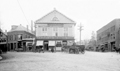 |
Harvard Square, Brookline Village, circa 1901
Washington St. continuing to the left, Harvard St. to the right. The Panter's Building has been sold and renamed to the Harvard Hall building. From left to right:
- Post Office
- 279 Washington St., the store of Nelson C. Thompson who took over the furniture and upholstery business from his father.
- The stores of Thomas H. Dyer, grocer, and Frank F. Seamens, Groceries. Both would remain until 1904 when the building was being prepped for replacement with the building that stands today. Dyer would hang on into 1905 in the building’s reduced and dilapidated state, as litigation was resolved.
- The E. S. Morse making deliveries of what is likely coal. The horses are drinking at the fountain.
- National Bank building at 1-5 Harvard St., still standing.
|
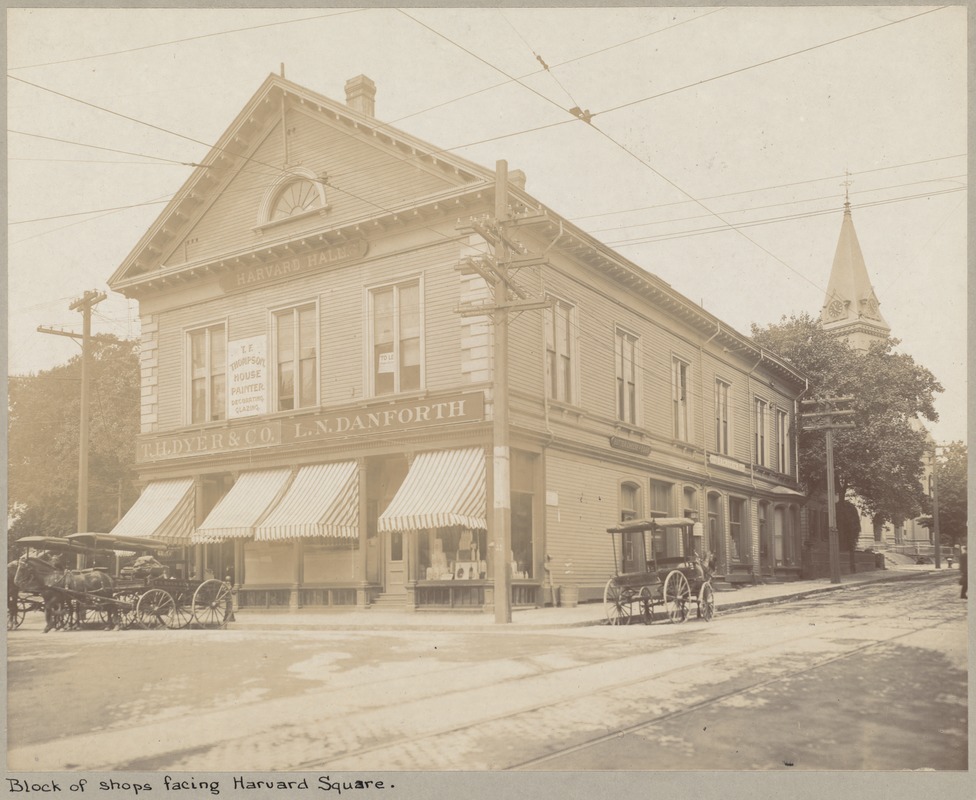 |
Harvard Square, Brookline Village, August 11, 1903
This photo shows the final stage of the full building at 11-13 Harvard Square. On the left, with its delivery wagons parked out front, is T. H. Dyer, Provisions. On the right, at #13 Harvard Sq., is Frank F. Seamens, Groceries recently renamed to L. N. Danforth. It appears that Lucius N. Danforth, a clerk at the Dyer store for two decades and at the George Joyce store there before that, has recently taken over the Seamens store. But the Danforth store will be short-lived. The town had that side of the building removed to allow for the widening of Harvard St. and a new building would replace it in two years.
[Source: Digital Commonwealth]
|
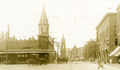 |
Harvard Sq., Brookline Village, circa 1910
Identified locations from left to right:
- Rhodes Bros., Groceries and Provisions. Opened in 1906 in the new building at 10-11 Harvard Sq. which still stands today.
- The two horses of the Twin Elm Spring Water delivery wagon drinking from the fountain. The banner on top advertises “Famous For Purity”
- The top of the steeple of the Baptist Church visible behind Rhodes Bros.
- An unidentified wagon with a man standing in its rear possibly making a delivery to a rear entrance of Rhodes Bros.
- St. Mary’s church at the corner of Harvard St. and Linden Place.
- The sign advertising « Ice Cream » of the Papouleas Confectionery store at 39 Harvard St.
- The store sign of T. H. Dyer, Provisions, above the awning, is visible at 33 Harvard St.
- The large brick building of the Brookline National Bank on the corner of Kent St.
[Source: Brookline Preservation Department]
|
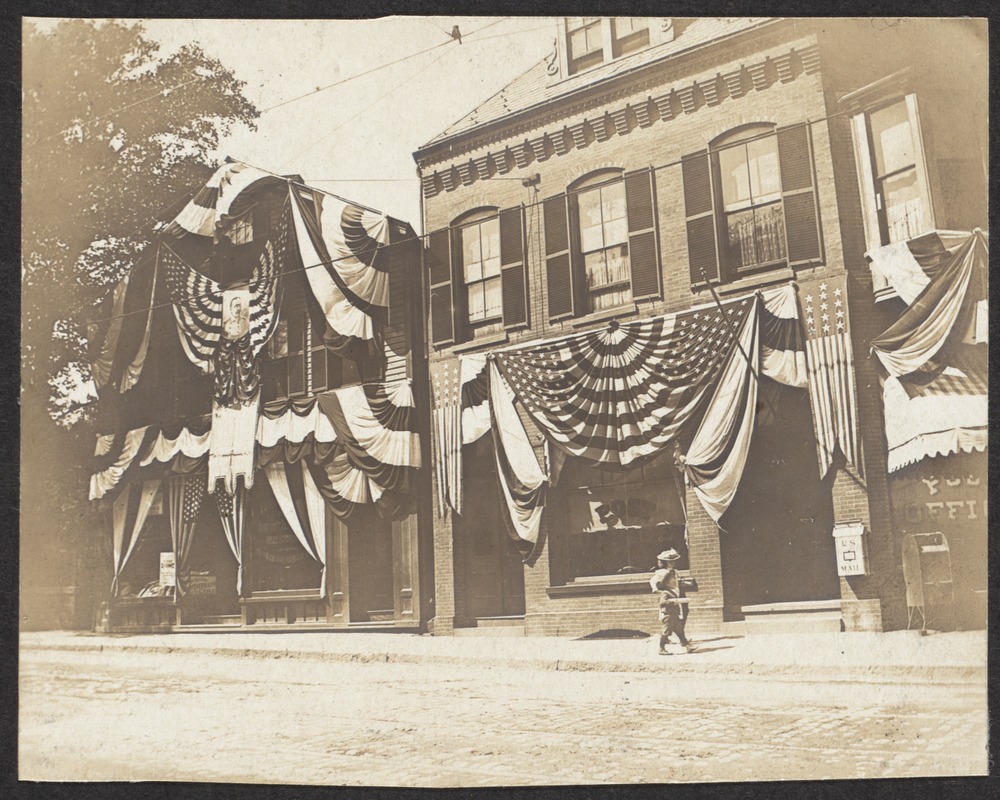 |
Harvard Square, Brookline Village, 1899
At the apex of Harvard and Washington Streets in Brookline Village, looking northwest on Washington St. The building on the right is the post office, at 283 Washington St. Identifiable businesses in the store on the left are the Postal Telegraph & Cable Co. and Frank A. Carnes, Real Estate at 289 Washington St.
This photo has long been misidentified (e.g. page 59 in Brookline, Massachusetts, A Pictorial History by Jean Kramer) as being part of the town’s 1905 bicentennial celebration. The clue to its real identity is the anomaly of the large picture of a man above the store fronts. It is Admiral George Dewey and he is being feted for his victory at the Battle of Manila in the Spanish American War. When Dewey returned from the Philippines to the United States on September 27, 1899, large parades in his honor were held in several major cities, including Boston on October 14, 1899 and it is probable that Brookline was also celebrating his victory in the fall of 1899, captured in this photo.
[Source: Digital Commonwealth]
|
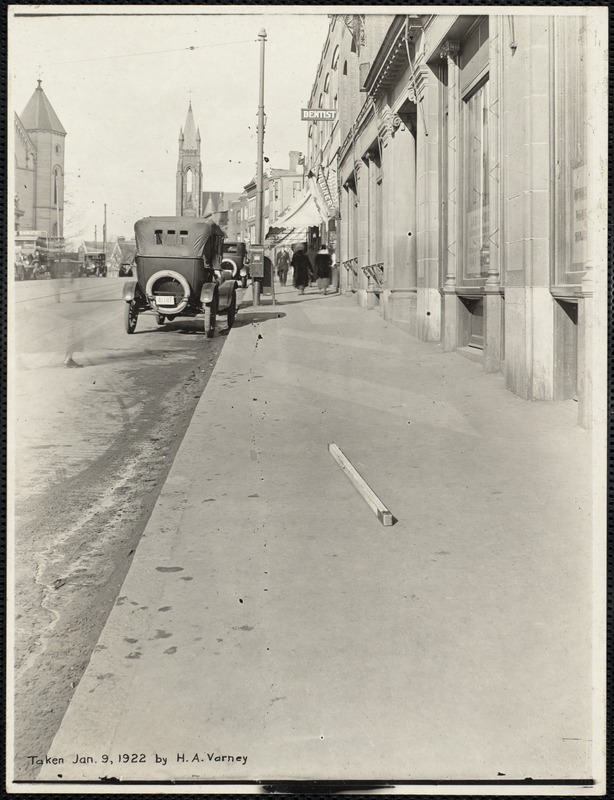 |
Brookline Village, January 9, 1922
Looking north on Harvard St. from Kent St. Photo by Henry A. Varney, Brookline town engineer.
- On the left is the smaller tower of the Baptist Church on the southwest corner with Pierce St., no longer standing
- In the far distance is the steeple of St. Mary's Church of the Assumption, still standing
- In the immediate foreground is the First National Bank building, #1-5 Harvard St., still standing
- Following the bank building is the building at #7–15 Harvard St. Seen are the signs for Wallace Ozon, dentist at #7 and Jennie Wilson, milliner, at #9. Still standing.
[Source: Digital Commonwealth]
|
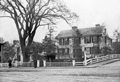 |
Brookline Village, Washington St. & Davis Ave, early 1860s
On the right is the entrance to Washington Place, today's Davis Ave. The Davis house was built in 1760 and demolished around 1867. The large tree and fences can be viewed in other photos from the 1860s.
|
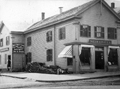 |
Brookline Village, Northwest Corner, Washington St. & Davis Ave.
Washington St. going north to the right; Davis on the left. The second floor was used by dancing and singing schools. Replaced by the brick Seamans building in 1889.
|
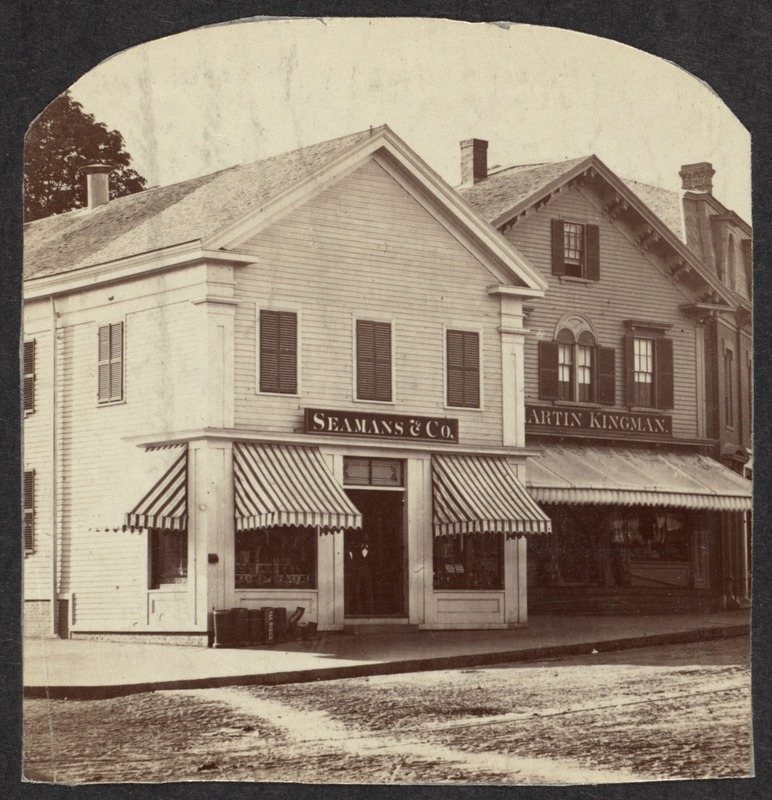 |
Brookline Village, Northwest Corner, Washington St. & Davis Ave.
Washington St. going north to the right; Davis just off screen on the left. James M. Seamans moved his grocery store, that had been in the lower Village since 1848, to this location in 1865. The Seaman's second floor was used by dancing and singing schools. In 1889, the store was replaced by the four-story brick building that remains today. Martin Kingman maintained a dry goods store next door from 1865 until 1875 when he sold the business to his assistant, Elizabeth Swift.
[Source: Digital Commonwealth]
|
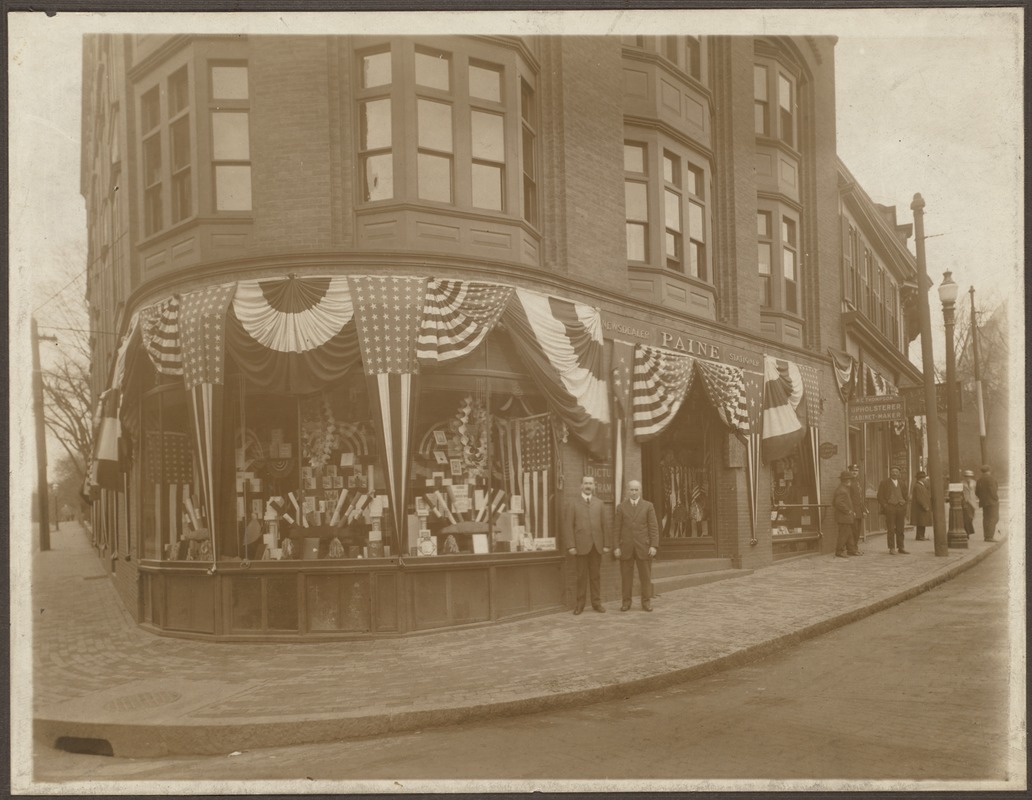 |
Brookline Village, Northwest Corner, Washington St. & Davis Ave.
This building, still standing at 256 Washington St., was constructed in 1889 by the Seamans as a replacement for their two-story wood-framed store. In 1911-12, William Dexter Paine, stationer, moved his store into the building from the longtime location at 239 Washington St. To the right, at 260 Washington St. is the business of Nelson C. Thompson, upholsterer, previously located directly across the street. Steverman & Gibbons, electricians, are at 264 and H. J. Murray, plumber, is at 266 Washington St. These businesses were collectively present here from 1912 to 1917.
[Source: Digital Commonwealth]
|
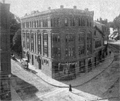 |
J. M. Seamans & Co.
256 Washington St., corner of Davis Ave. In 1889, James Manning Seamans replaced his wooden two-story store with this brick building that still stands. His son, Manning Seamans, took over the business from his father. Upon the latter’s death in 1910, the business was closed and replaced by William Dexter Paine, Stationer.
[Source: Brookline Preservation Department]
|
|
 The Society
 Program Archives