|
The Society
Historical Information
Photo & Map Collections
Exploring Brookline
Links
Program Archives
|
Photo Collection
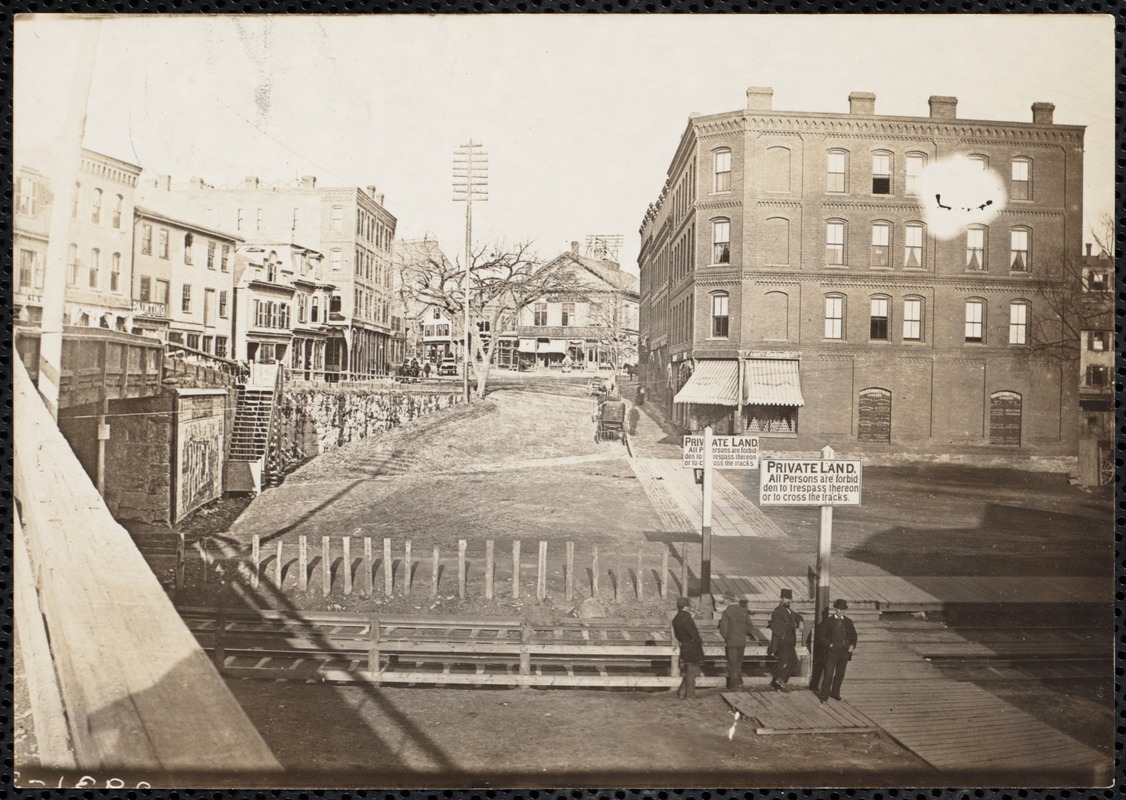 |
Brookline Village, 1885
Looking north on the east side of Washington St. are the three Colonnade buildings that still stand today. Shortly after this photo was taken there was a major regrading and widening of Washington St. and the creation of Station St. This was undertaken to increase the width of the narrow bridge over the tracks. The dirt ramp would become an extension of the bridge and this necessitated raising the nearest brick Colonnade building to its present height.
The awnings on the near corner of the Colonnade buildings are for Nelson Bros., Grocers, "dealers in fine teas and pure coffees" Also still standing today, on the west side of Washington St., are the two tallest buildings in the photo, both brick.
[Source: Digital Commonwealth]
|
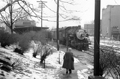 |
Brookline Village Station, January 18, 1941
Boston and Albany Railroad Locomotive No. 307, looking east. The house at 21 Pearl St. and the rear of the movie theater are on the right.
|
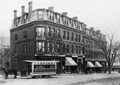 |
Brookline Village, circa 1873
This unique photo is a rare photo of the early stages of the expansion of Brookline Village northward away from the business center on Lower Washington St. It shows the first two buildings of Colonnade Row which have just been built and populated with the initial businesses. A third building would be added on the right in 1875. All are still standing as are the original cast-iron pillars visible on the store fronts.
The horse-drawn car is being pulled on rails which were first laid in 1859 to effect a much-needed improvement over the slow and bumpy rides of the trackless Omnibuses which were essentially enlarged stage coaches. This horse car is being pulled northward either to the final stop at Washington and School Streets or to the final stop at Harvard and School Streets. At these final stops the horse(s) would be unhitched and attached to the other end of the car and the route retraced.
There are three stores in the building on the left:
- The first store, at #243, appears unoccupied
- In the middle, at #239, is the dry goods store of Walter Martin
- On the right, at #235, is the grocery store of George F. Joyce who would later expand and relocate up the street
There are three stores in the building on the right:
- The store on the left, at #227, is the apothecary of Charles P. Ladd
- In the middle, at #223, is the store of George Turnbull, the first tailor in Brookline
- On the right, at #219 Washington St., is the Brookline Savings Bank which had just been incorporated in 1871
In the distance the old railroad depot can be glimpsed with a sign for the American Telegraph Company. It also housed the post office.
[Source: Leo Sullivan]
|
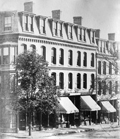 |
Colonnade Buildings, Brookline Village, circa 1874
Shown are the first two buildings of the three-building Colonnade group, all still standing. The three stores with awnings, left to right, are:
- Charles F. Lamb, Dry and Fancy Goods, at 239 Washington St.
- H. Frank Rich, Books and Stationery, at 235 Washington St. He lived in Brookline and his main store was at 25 West St., Boston. He opened this store in 1873 and there is no record of it past 1874.
- The apothecary of Charles P. Ladd at 227 Washington St. in the second building
[Source: Brookline Public Library]
|
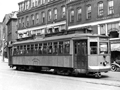 |
Trolley Car, Brookline Village
Washington St. heading toward Rt. 9 and Boston. This is a Type Four car, in use in Boston from 1911-1950. The two brick buildings still stand. While nominally just a photo of a subway car this photo actually contains a number of interesting details of Village life in the late 1930s. To the right is the front end of what appears to be a 1935 Chevrolet Master Deluxe Coupe. And there are glimpses of the following businesses:
- Earl Colvin, dentist, is the clearest. He was at that location (221 Washington Street) as early as 1922 and as late as 1940. In 1944 he had moved to 1 Harvard Street.
- Moore's, up the street, is Moore's Grille at 6-9 Harvard Square.
- A.J. Grennan, Chiropodist.
- Wolf & Smith, Meats. They are beneath Colvin and the name is only partly visible. They were there as early as the 1920s through at least 1944.
- Elisabeth Cleansing Shop. The name is on the corner above the back of the trolley.
- Daniel Goldberg. His name is on the window next to Grennan, but we don't find him in the city directories.
|
 |
Harvard St., Corner Babcock St.
335 – 315 Harvard St. The post office at 331 Harvard St. and the American Oriental Rug Co. at 321 Harvard St. are identified. Babcock St. is at the extreme right. The building still stands but with a greatly modified exterior.
[Source: Brookline Preservation Department]
|
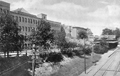 |
Holtzer Cabot Electric Co., Brookline Village, 1915
Station St., building still in use. Train station is now the Brookline Village MBTA stop. In 1891, the company developed the first successful electric carriage in the U.S.
|
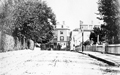 |
Davis Ave.
Looking east toward Washington St. The store front of James Rooney, Boots & Shoes, at #1 Harvard Sq. can be seen. He, and later his son, maintained their store there for four decades.
[Source: Brookline Public Library]
|
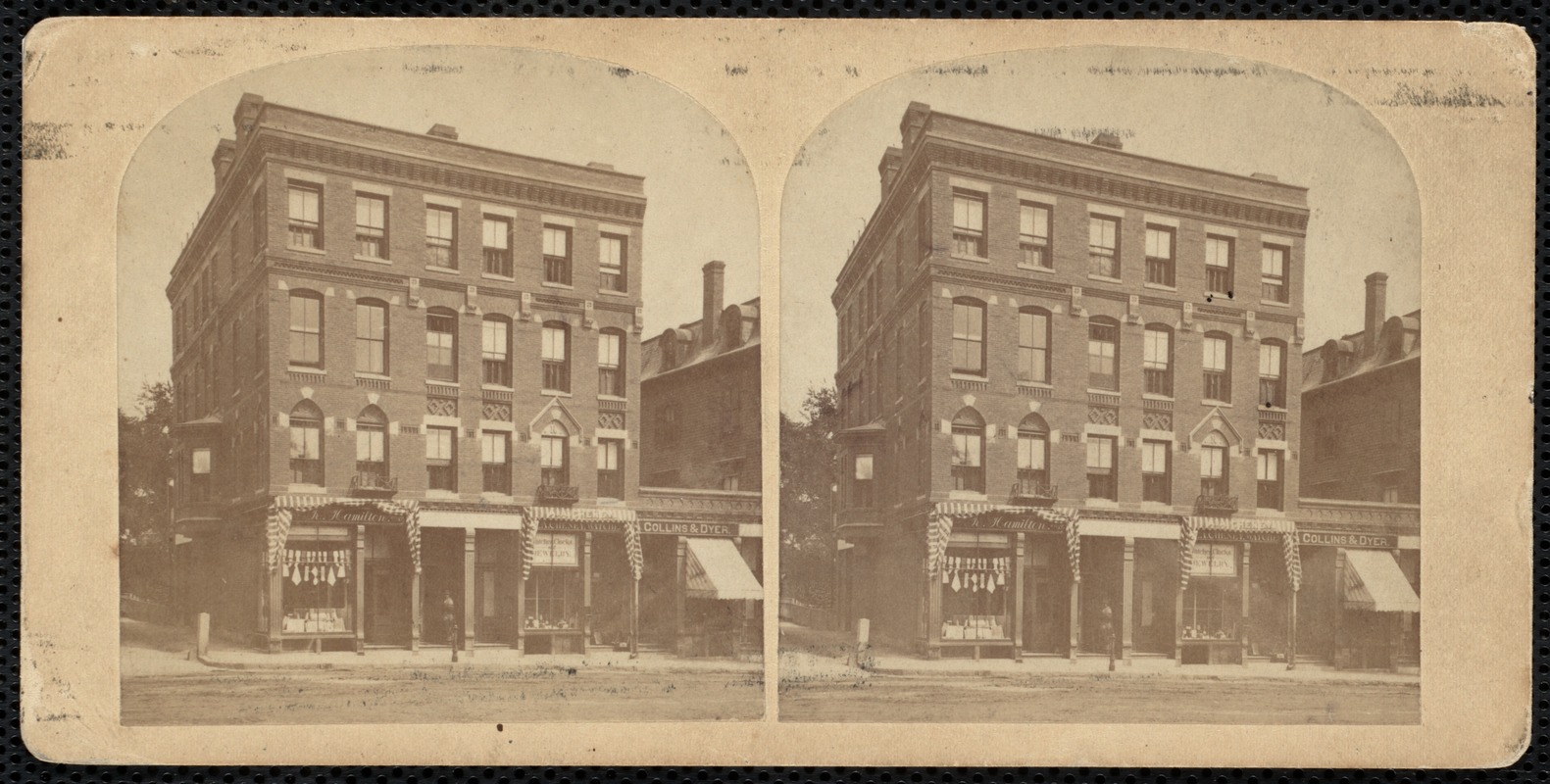 |
Brookline Village, circa 1877
Between Kent St. and Andem Pl. there are three buildings, two visible here, known as the Rooney Block. From left to right:
- Robert Hamilton, Dry and Fancy Goods, at #9 Harvard Sq.
- A. A. Cheney, Watchmaker and Jeweler, at #6 Harvard Sq.
- Collins and Dyer, Provisions, #5 Harvard Sq. Thomas H. Dyer left soon after this photo was taken to work at the provisions store of Hartwell & Skinner in Boston's New Faneuil Hall Market and returned to open his own store in the nearby Panter Building in May 1882. When Dyer left, this store became Henry Collins & Co., Provisions.
[Source: Digital Commonwealth]
|
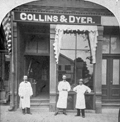 |
Collins and Dyer, Provisions, 5 Harvard Sq.
This is the one-story building in the middle of what was known as the “Rooney Block” and still stands today. Henry Collins and Thomas H. Dyer were partners at this location from about 1873 – 1877. Dyer left to work at the provisions store of Hartwell & Skinner in Boston's New Faneuil Hall Market and, by 1883, had returned to Brookline to open his own store in the nearby Panter Building. When Dyer left, this store became Henry Collins & Co., Provisions.
In the window, the reflection of the Seaman’s Co. building, situated directly across Washington St. on the northwest corner with Davis Ave , is clearly visible.
[Source: Brookline Preservation Department]
|
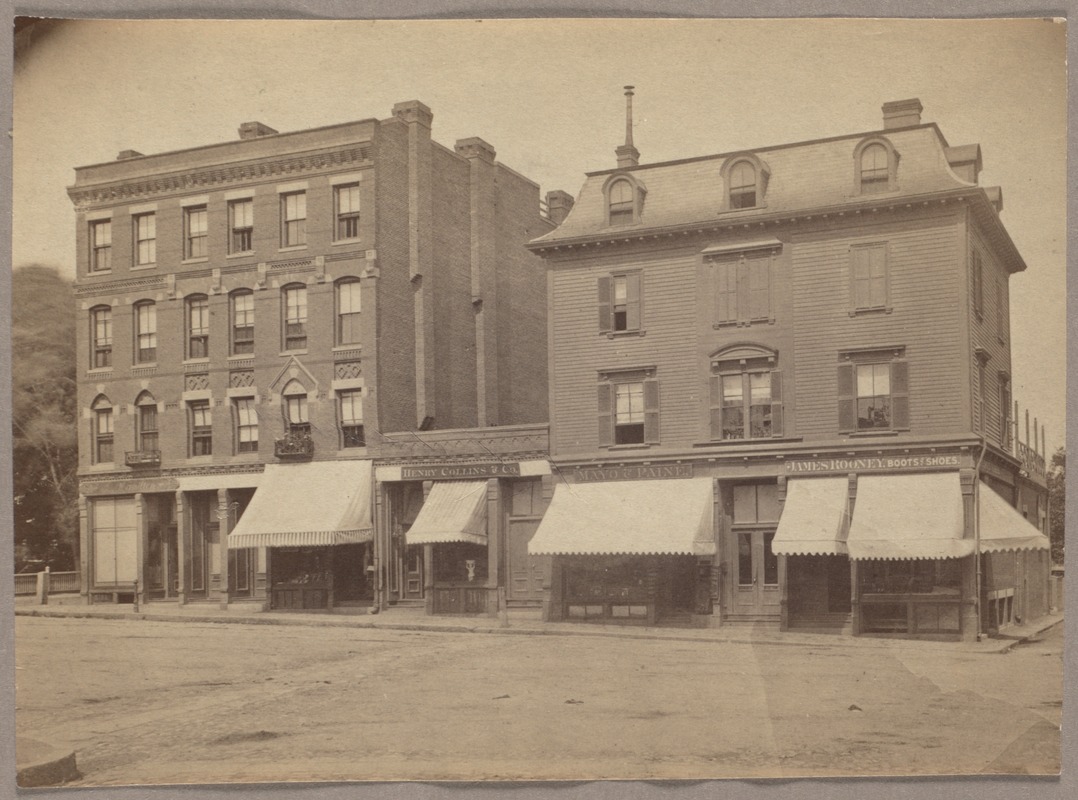 |
Harvard Square, Brookline Village, circa 1880
The one-story building, still standing in the center of the complex known as the "Rooney Block", houses Henry Collins & Co., Provisions. To the right, the store of Mayo & Paine Stoves became, circa 1883, the Paine Brothers when Mr. Mayo left the business and Henry K. Paine went into business with his brother, Isaac. The store of James Rooney, Boots and Shoes, is on the far right.
[Source: Digital Commonwealth]
|
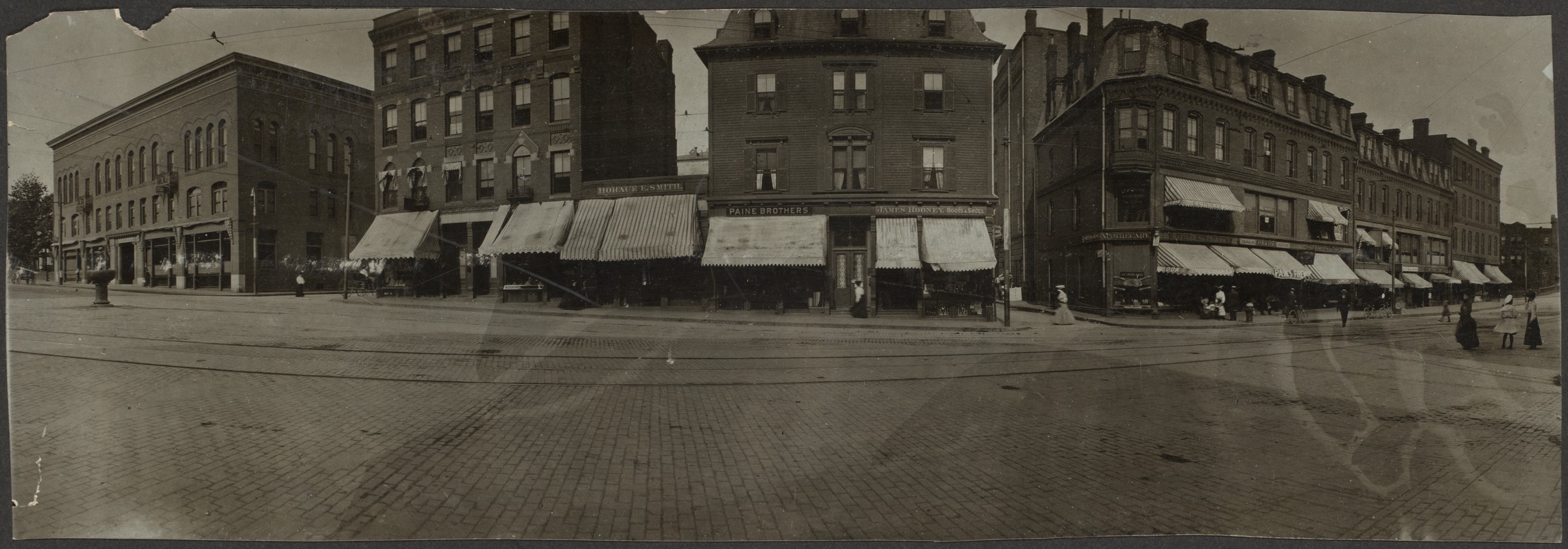 |
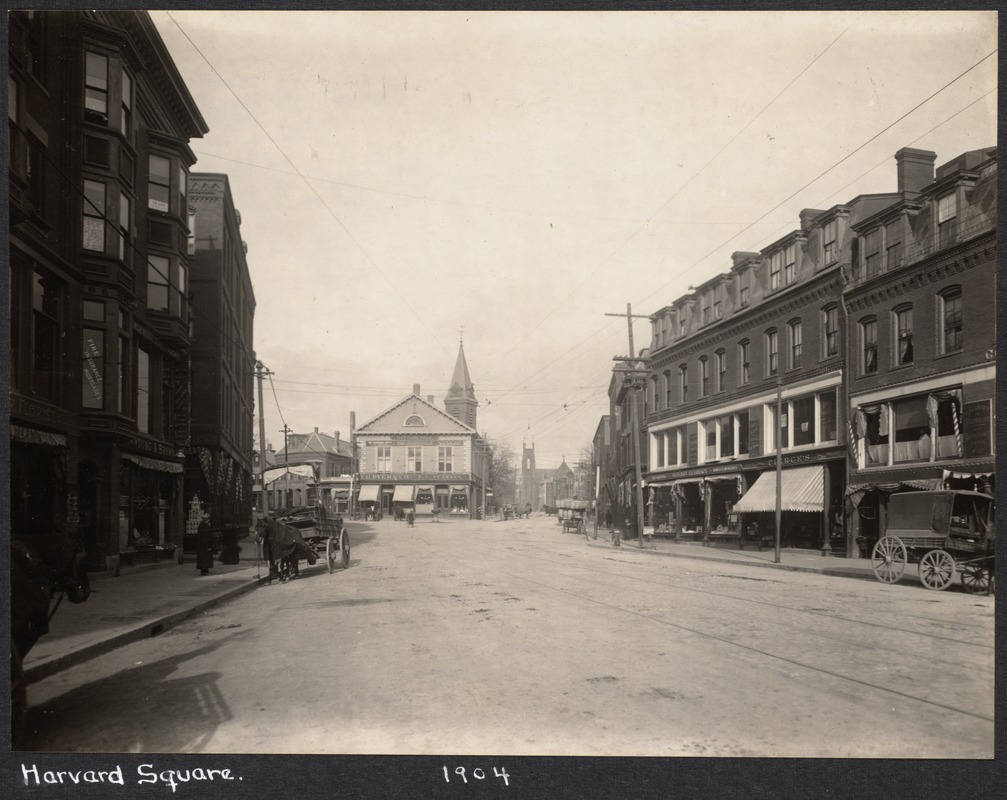
Brookline Village, circa 1904
The eastern side of Harvard Sq. and Washington St. can be described in three sections defined by the side streets of Kent and Andem Place. All these buildings are still standing. From left to right:
LEFT BLOCK:
The National Bank building on the east side of Harvard St., between Webster Pl. and Kent St., is still standing. It housed the National Bank and the Post Office on the first floor. The horse-watering fountain in the middle of Harvard Sq. is also visible.
CENTER BLOCK:
Between Kent St. and Andem Pl. there are three buildings known as the Rooney Block, they are addressed as Harvard Sq.
- In the first building are C. A. Delano, Dry Goods, at #9 Harvard Sq.; and George M. Harper, Fish, at #6 Harvard Sq. (awning visible).
- In the one-story middle building, #5 Harvard Sq., is Horace E. Smith, Provisions.
- The right-hand building (the upper floors were later rebuilt in brick) houses Paine Brothers (Henry K. and Isaac), Plumbers, at #3 Harvard Sq.; and James Rooney Boots & Shoes at #1 Harvard Sq. In between is the door for #2, a rooming house called Somerset House. In a photo from 1908 there is a sign announcing Board and Room By Day or Week, Single Meals
RIGHT BLOCK:
Between Andem Place and Station St. are three large buildings, known as the Colonnade Buildings, all still standing.
Left Building
- On the corner at #241-243 Washington St. stands the Harvard Sq. Pharmacy, run by David C. Hickey.
- At #239 is the newsstand and stationary store of William Dexter Paine who was a son of Isaac Paine of the previously mentioned plumbing store.
- Nestled between the awnings of #239 and #235 is the door at #237 Washington leading to establishments upstairs. The awning for T. J. Turley & Son, tailors, is visible as is the window sign for Mrs. J. F. Hickey, dressmaker.
- Back on the first floor at #235 the awning of Everett E. Pierce, baker and caterer, is visible. To the right of him is the door for #231 leading to the several businesses upstairs.
Middle Building
The middle building still displays the Colonnade Buildings lettering today.
- The last store on the right, at #219 Washington St., is Frank Russell, real estate
Right Building
- The Edwin F. Crosby plumbing and kitchen goods store is on the left at #213 and #211
- On the right-side corner is Nelson Bros., Grocers, at #205 Washington St.
[Source: Digital Commonwealth]
|
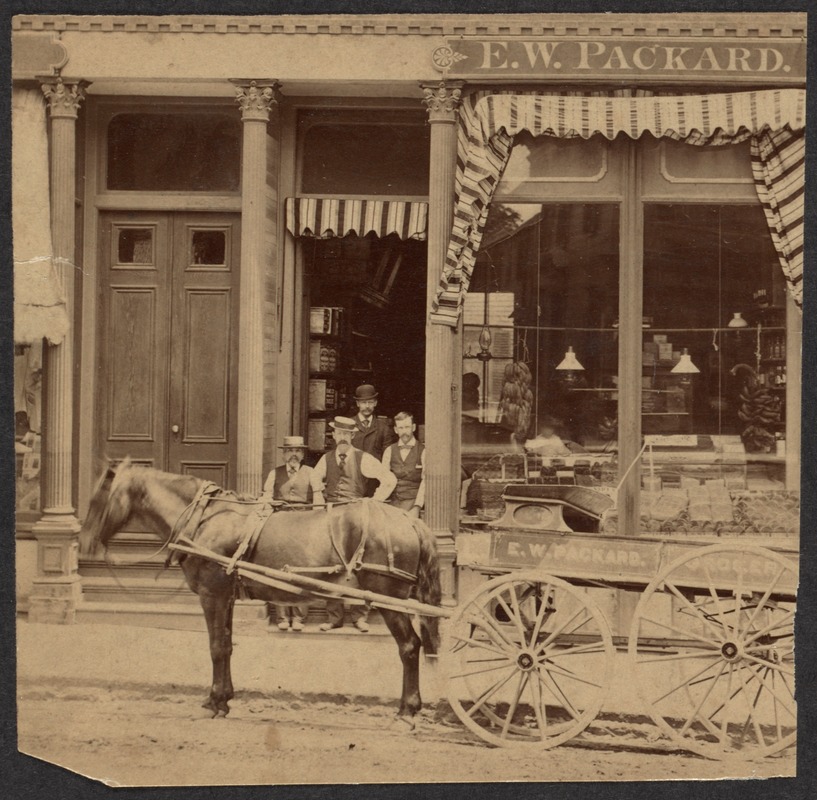 |
Edward W. Packard, Grocer, Brookline Village
This is the center of the three Colonnade buildings. On the left is the door to today’s 221 Washington St. leading upstairs. On the right is 219 Washington St. The three cast-iron pillars remain today.
After fighting in the Civil War and marrying in 1872, Edward W. Packard joined, circa 1875, Solomon Burt to open a grocery store, Solomon & Burt, in the Village Square. Edward’s brother, Eugene, soon joined the business. By 1879, the Packard brothers had opened this, their own store, in the nearby Colonnade Building. By 1881, they had four employees listed in the Brookline directory, possibly those seen in the photo – the two Packard brothers, Emerson C. Ball, and Frank A. Morse. The business closed in early 1886.
[Source: Digital Commonwealth]
|
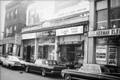 |
202 -222 Washington St.
All buildings still stand.
[Source: Brookline Preservation Department]
|
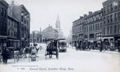 |
Harvard Square, Brookline Village, 1905
Looking north from Washington St.
|
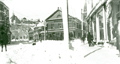 |
Brookline Village, circa 1898
Special Notes:
- There were three major snowstorms around this time that can be considered in dating this photo: February 13, 1899; November 27, 1898; and January 28, 1897
- There is a large unexplained group of men massed outside the front door of the T. H. Dyer store.
From left to right in the group of buildings in the center of the photo:
- 287-289 Washington St. The sign is not legible
- 285 Washington St., the post office. By 1902, it had moved over to the National Bank Building, a few doors to the right and across Harvard St.
- 279 Washington St.. The store of Nelson C. Thompson who took over the furniture and upholstery business from his father.
- 13 Harvard Sq., the grocery store of T. H. Dyer. li>
- 11 Harvard Sq., Frank F. Seamens, Groceries
- 4 Harvard St. (on the right side of the Harvard Hall building), entrances to upstairs businesses: Brookline Co-op Bank; Riverdale Press; Brookline Chronicle, Charles A.W. Spencer, proprietor.
- 8 Harvard St. (on the right side of the Harvard Hall building), the sign for Charlie Sing, Laundry is visible.
- Also visible in the right foreground corner of the photo is the partially obscured “Catering” sign for the store of Everett E. Pierce, baker and caterer.
[Source: Brookline Preservation Department]
|
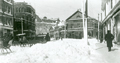 |
Brookline Village, circa 1898
Special Notes:
- There were three major snowstorms around this time that can be considered in dating this photo: February 13, 1899; November 27, 1898; and January 28, 1897
- There is a large unexplained group of men massed outside the front door of the T. H. Dyer store.
From left to right in the group of buildings in the center of the photo:
- 287-289 Washington St. The sign is not legible
- 285 Washington St., the post office. By 1902, it had moved over to the National Bank Building, a few doors to the right and across Harvard St.
- 279 Washington St.. The store of Nelson C. Thompson who took over the furniture and upholstery business from his father.
- 13 Harvard Sq., the grocery store of T. H. Dyer. li>
- 11 Harvard Sq., Frank F. Seamens, Groceries
- 4 Harvard St. (on the right side of the Harvard Hall building), entrances to upstairs businesses: Brookline Co-op Bank; Riverdale Press; Brookline Chronicle, Charles A.W. Spencer, proprietor.
- 8 Harvard St. (on the right side of the Harvard Hall building), the sign for Charlie Sing, Laundry is visible.
- Also visible in the right foreground corner of the photo is the partially obscured “Catering” sign for the store of Everett E. Pierce, baker and caterer.
[Source: Brookline Preservation Department]
|
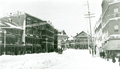 |
Brookline Village, circa 1898
Visible on the left:
- 214 Washington St., Kenrick Bros., Plumbers
- 222 Washington St., “Law Office” sign in the upstairs window probably for the office of Foster and Nash, lawyers
- 222 Washington St., the upstairs office of John F. Fleming, gasfitter and electrician
- 224 Washington St., Young & Brown, pharmacy
In the center:
- 287-289 Washington St. The sign is not legible
- 285 Washington St., the post office. By 1902, it had moved over to the National Bank Building, a few doors to the right and across Harvard St.
- 279 Washington St., the store of Nelson C. Thompson, furniture and upholstery.
- 13 Harvard Sq., the grocery store of T. H. Dyer in the Harvard Hall building.
- 11 Harvard Sq., Frank F. Seamens, Groceries, in the Harvard Hall building
On the right foreground:
- 205 Washington St. on the corner with Station St., Nelson Bros., Grocers
[Source: Brookline Preservation Department]
|
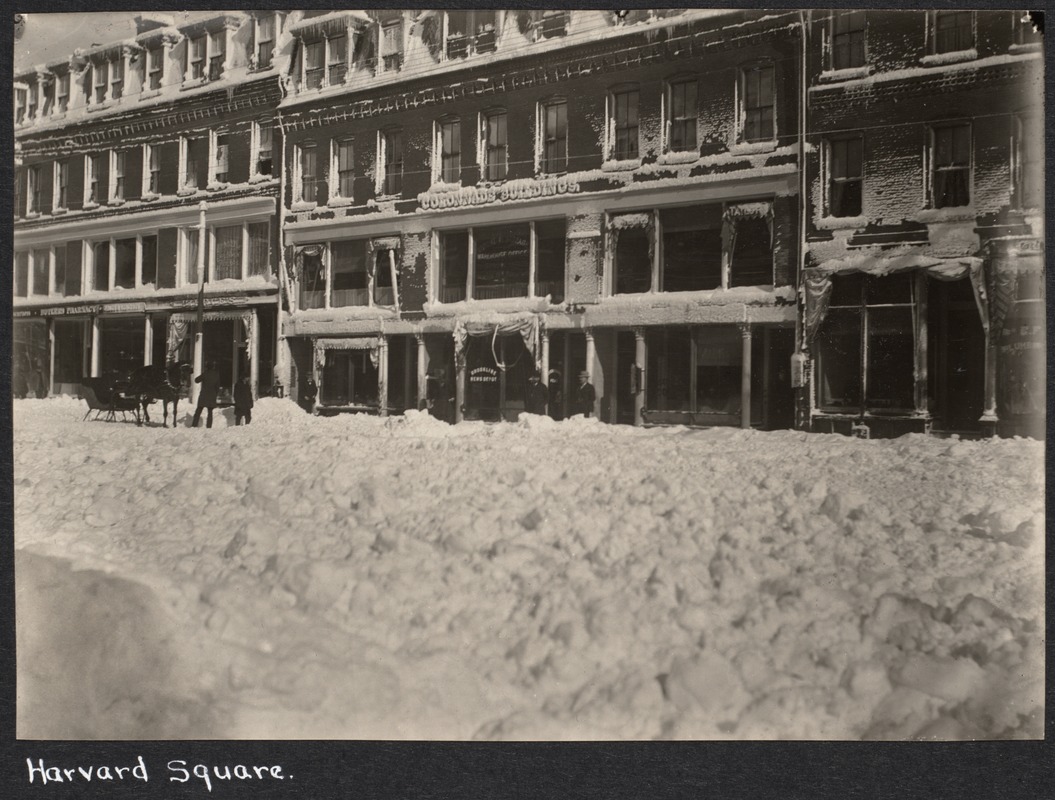 |
Brookline Village, circa 1898
Visible from left to right:
- 239-241 Washington St., William H. Butler, Apothecary
- 235 Washington St., Everett E. Pierce, baker and caterer, right side of the first Colonnade Building
- 225 Washington St., Brookline News Depot, center of the second Colonnade Building
- 221 Washington St., upstairs sign of the Brookline Storage Warehouse Office in the second Colonnade Building
- 211 Washington St., a partial view on the right of Edwin F. Crosby plumbing and kitchen goods, in the third Colonnade Building
[Source: Digital Commonwealth]
|
 |
Brookline Village, December 1899
This photograph was taken in December 1899 by the “special photographer” of The Suburban newspaper and was printed on the front page of the January 2, 1900 issue.
In the darkened building on the left:
- 220 Washington St., a partial view of F. E. Palmer, Florist
- 222 Washington St., sign in the window for the upstairs office of Frank G. Russell, Real Estate and Fire Insurance
- 222 Washington St., the upstairs office of John F. Fleming, gasfitter
- 224 Washington St., Young & Brown, pharmacy
In the center:
- 279 Washington St.. the store of Nelson C. Thompson who took over the furniture and upholstery business from his father.
- 13 Harvard Sq., the grocery store of T. H. Dyer.
- 11 Harvard Sq., Frank F. Seamens, Groceries
- 4 Harvard St. (on the right side of the Harvard Hall building), entrances to upstairs businesses: Brookline Co-op Bank; Riverdale Press; Brookline Chronicle, Charles A.W. Spencer, proprietor.
- 8 Harvard St. (on the right side of the Harvard Hall building), the sign for Charlie Sing, Laundry is visible.
On the right:
- 239-241 Washington St., William H. Butler, Apothecary
- 235 Washington St., Everett E. Pierce, baker and caterer, right side of the first Colonnade Building
- 227 Washington St., upstairs sign for Charles A. Lunney, Plumber is visible, above the wagon, in the second Colonnade Building
[Source: Digital Commonwealth]
|
|

 The Society
 Program Archives