|
The Society
Historical Information
Photo & Map Collections
Exploring Brookline
Links
Program Archives
|
Photo Collection
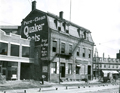 |
Village Square, 1912
Looking east at Lower Washington St. from Boylston St. From right to left:
- 160 Washington St.: Guild Building. at the corner. This side of the building would soon be removed for the widening of Boylston Street.
- 7 – 11 Boylston St., under construction. The demolition permit for the existing building (9-11 Boylston St.), affected by the incipient widening of Boylston Street, was granted in July, 1912; construction was completed by the end of the year; and an additional address, #7, was added.
- 7 Boylston St. After many years at 157 Washington St., hairdresser Martin Geier is about to move his business here. On January 1, 1913 the Brookline Equal Suffrage Association opened their offices upstairs.
- 5 Boylston St., the fading sign for the grocery store of Francis H. Bacon remains but the business was taken over by Thomas McMahon a number of years ago.
- 166 Washington St., upstairs in the Guild Building. Signs for Forster Bros., Upholsterers and
The Brookline Print (Wallace B. Conant and Carl A. Smith), job printers, are visible.
- 157 Washington St., in the distance, the sign for Brookline Provisions is visible.
[Source: Brookline Preservation Department]
|
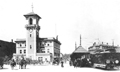 |
Station A (Now Station 1), Brookline Village, circa 1910
Trolley station erected. Small bushes planted on side of station.
|
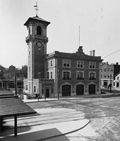 |
Station A (Now Station 1), Brookline Village, circa 1910
From left to right:
- 32 Allerton St., rear, high on the hill (still standing)
- 34 Walnut St., Edward J. Kirker, Real Estate; Brookline Press
- 38 Walnut St.: Mark Bergstein, Tailor
- 40 Walnut St.: Eagle Hand Laundry
- The fire station. Note underground toilets to the left.
- 1 High St.: Michael W. Quinlan, Carriage Mfg.
- 9 High St., brick apartment building, partial view
[Source: Brookline Preservation Department]
|
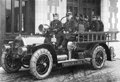 |
Station A (Now Station 1), Brookline Village, 1910
The 1909 Knox chemical and hose wagon, the first motorized fire-fighting vehicle purchased by the town. It was known as "Combination A" and ushered in the end of the horse-drawn era. Pictured are:
- George Murray, driver
- John Allen, Assistant Chief, next to the driver
- John O’Neil, rear, first on the left
- Two unidentified men, rear left
- Lt. Frank T. Pons, Sr., at the back
- Lt. Frank Hayes, Sr., rear right
[ref. The Brookline Chronicle, August 22, 1968, pg. 1]
|
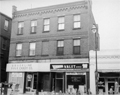 |
167 and 163 Washington St.
This photo was taken prior to the leveling of the block for the Hearthstone Plaza and the leveling of the entire area then known as “The Marsh”. The business of the Brookline Bulk Candy was deemed by the Brookline Redevelopment Authority to be neighborhood-specific and was relocated across the street at 216 Washington St. By contrast, the Ames Supply Co., partially viewed on the left, was not given an option to relocated nearby.
From a notebook of property-appraisal photos taken in 1965 and early 1966 for “The Marsh Urban Renewal Project” run by the Brookline Redevelopment Authority. Only a few scattered peripheral structures remain today.
|
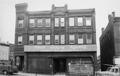 |
171 Washington St.
The tracks to the “D” subway line lie immediately to the left. The building anchored the northwest corner of the area then known as “The Marsh” that would soon be completely leveled in an urban renewal project. Ames Supply Co. was one of thirteen businesses forced out by the Brookline Redevelopment Authority, being deemed not essential to Village Life and therefore not eligible for local relocation on redeveloped land.
From a notebook of property-appraisal photos taken in 1965 and early 1966 for “The Marsh Urban Renewal Project” run by the Brookline Redevelopment Authority. Only a few scattered peripheral structures remain today.
|
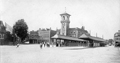 |
Brookline Village, circa 1910
Fire station #1 and the new trolley island
|
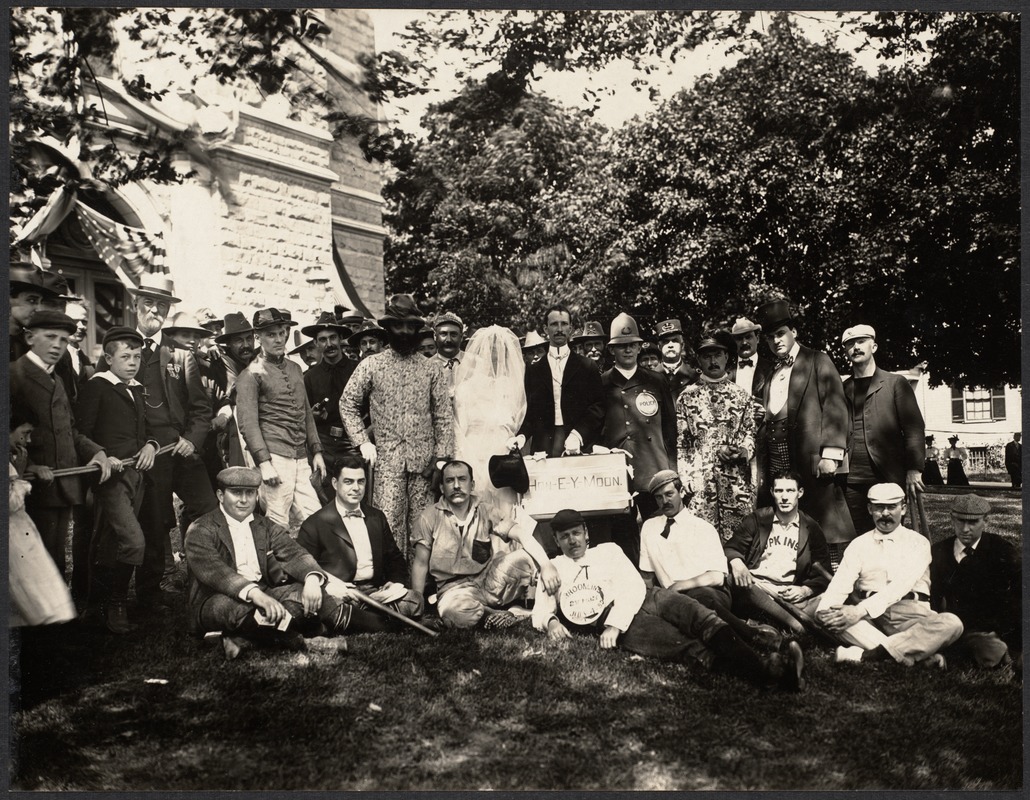 |
Post Parade Gathering, July 4, 1899
In the late 1800s Brookline hosted an annual parade on the Fourth of July with elaborate and sometimes outlandish floats and costumes for which prizes were awarded. Some of those gathered here in front of town hall after the parade were float participants. The photo was one of a group of photos published in The Suburban newspaper, July 8, 1899, pg. 2. This one was labeled “The Old Timers, July Fourth, 1899”.
[Source: Digital Commonwealth]
|
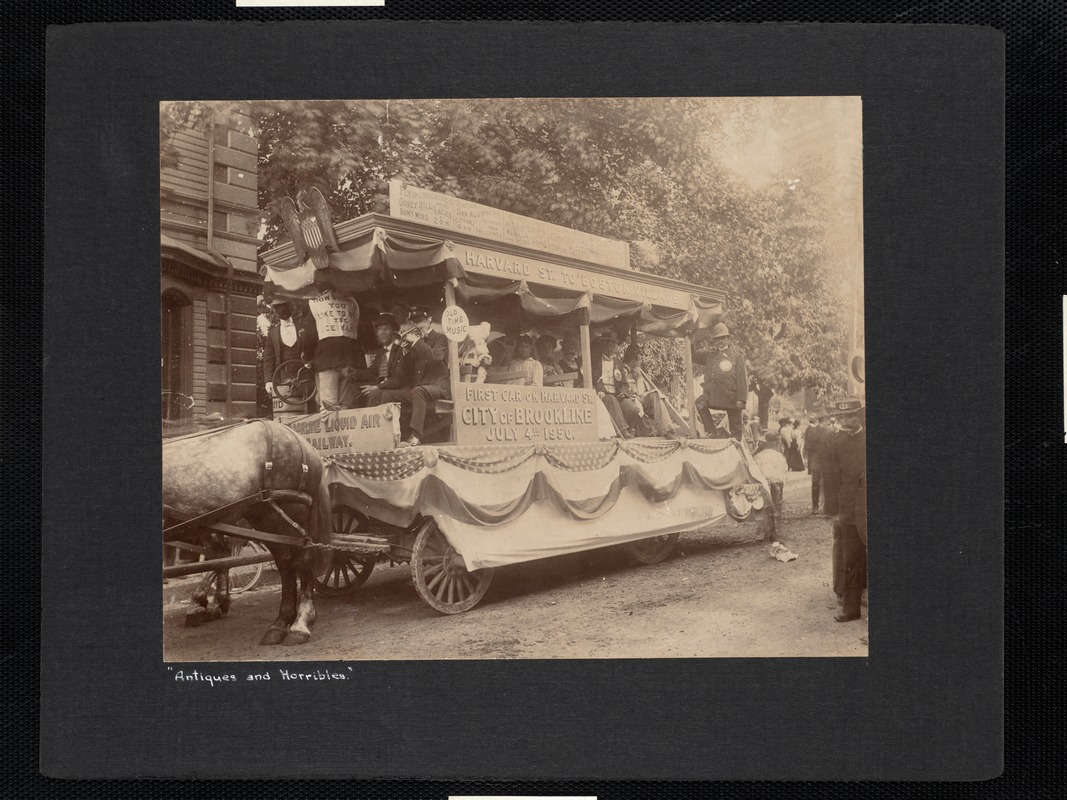 |
Fourth of July Parade, 1899
The float pictured, “Opening of the Liquid Air Railway Line”, won the prize for “best local hit” in the annual Fourth of July parade for 1899. It was a “burlesque” on an imagined future trolley line on Harvard St. powered by the just-developed “liquid air”. This was undoubtedly inspired by the recent lecture delivered to a huge crowd in town hall, on April 4, by William Peckham, an electrical engineer from New York. He had been advancing new manufacturing methods for liquid air and fantastical claims were being made for its potential (a company was developing an automobile named “Liquid Air” with the prediction of being able to travel long distances when powered by liquid air.)
The people on the float are playing various roles imagined for the world of 1950. The parade route: begin Harvard Sq., north on Washington St., right on Park St., right on Beacon St., right on Charles St., left on Sewall Ave., right on Kent St., right on Aspinwall Ave., left on Harvard St., continue south on Washington St. to the Village Sq., right on Boylston St., right on Cypress St. to the playground by Davis Ave.
From a series of photos published in The Suburban newspaper, July 8, 1899, pg. 2.
[ref. The Brookline Chronicle, April 8, 1899, pg. 18].
[ref. The Suburban, July 8, 1899, pg. 4]
[Source: Digital Commonwealth]
|
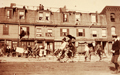 |
Bike Parade, circa 1900, Brookline Village
Looking at the west side of Washington St. across from Station St. This is most likely a Fourth of July parade. The stores pictured were at this location in 1899 and 1900. From left to right:
- #188, James Terry, Shoe Repair (partial)
- #192, Thomas Mahon and Sons, Plumbers
- #194, Flately and Sweeney, Custom Tailors
- #198, John T. Cahill, Provisions
- #200, James B. Hand, House Painter and Decorator
- #208 Washington St., the Chace building, still standing (partial)
[Source: Brookline Preservation Department]
|
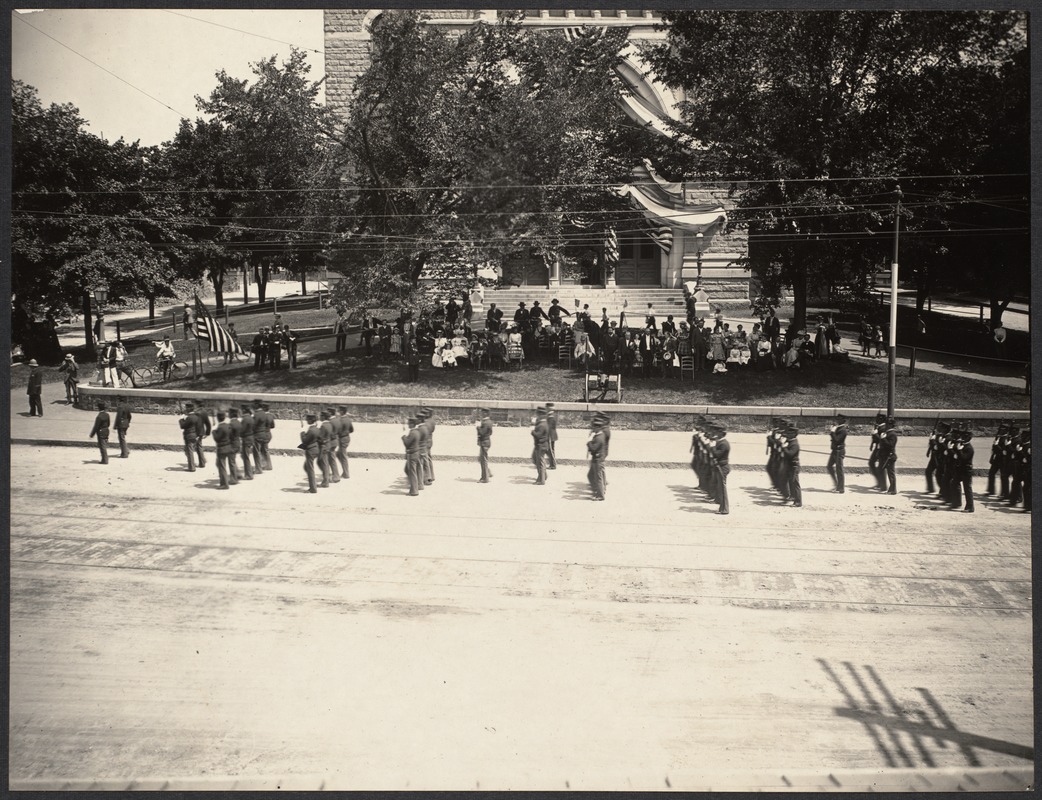 |
Fourth of July Parade, 1899
The procession passes in front of Town Hall.
One of a series of photos taken for the The Suburban newspaper.
[Source: Digital Commonwealth]
|
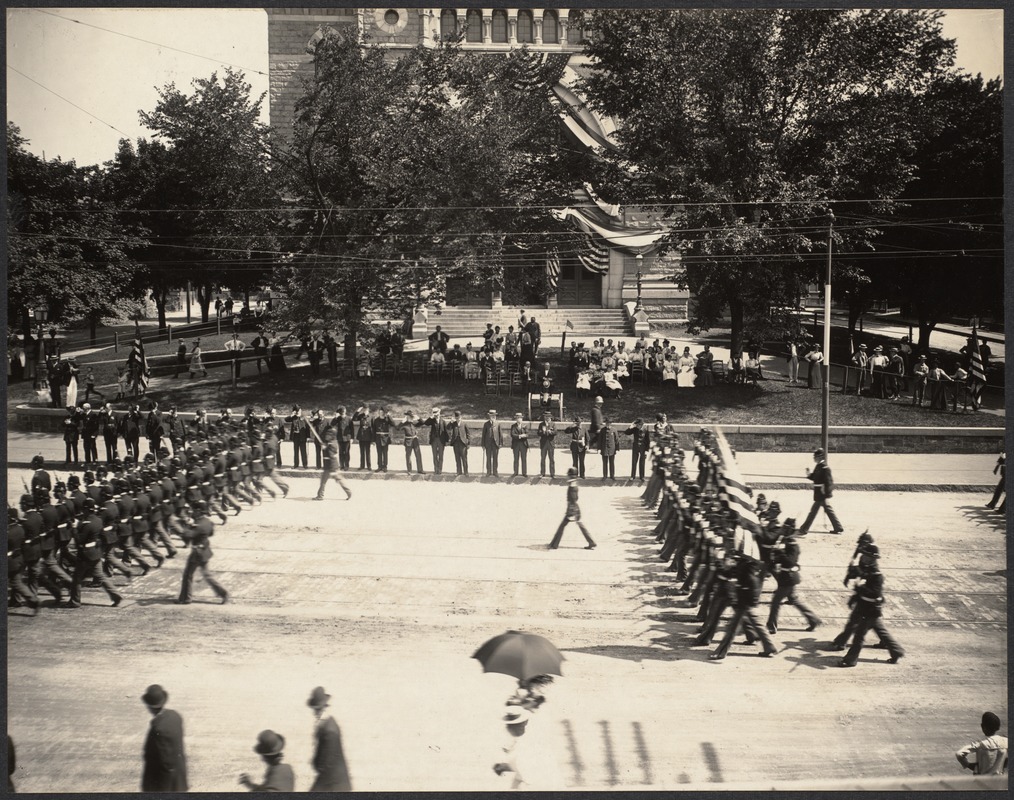 |
Fourth of July Parade, 1899
The procession passes in front of Town Hall.
One of a series of photos taken for the The Suburban newspaper. A cropped version entitled “Review of the Troops by the Selectmen in Front of Town Hall” appeared on page 2 of the July 8, 1899 issue.
[Source: Digital Commonwealth]
|
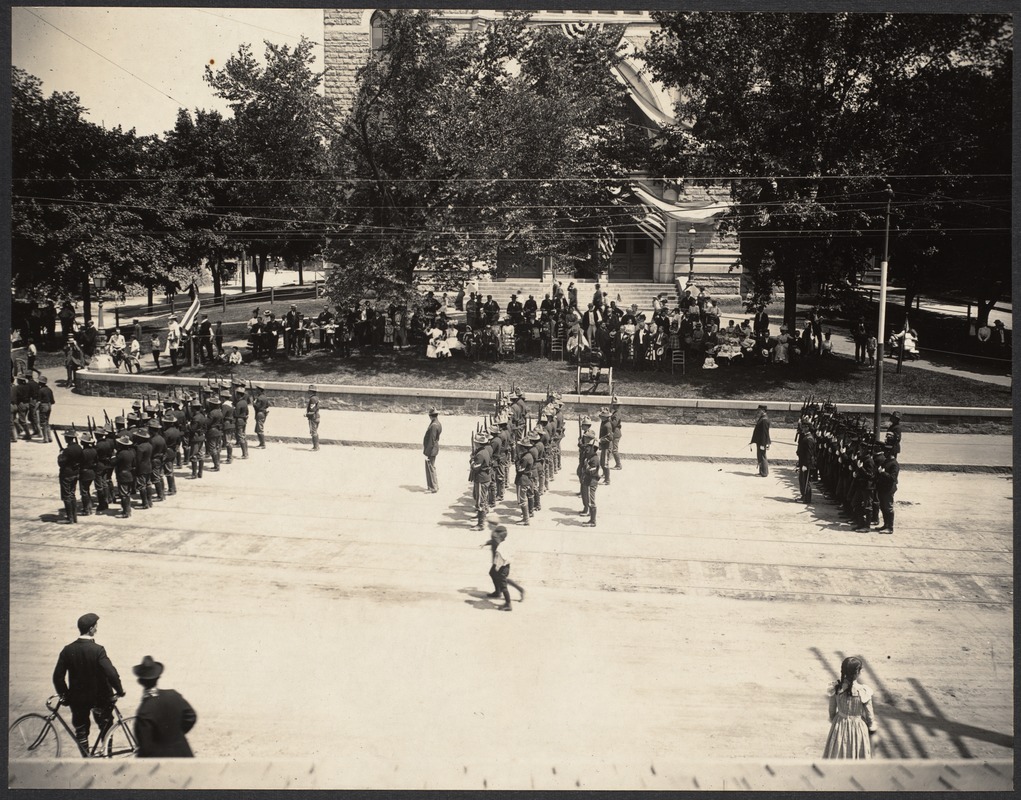 |
Fourth of July Parade, 1899
The procession passes in front of Town Hall.
One of a series of photos taken for The Suburban newspaper.
[Source: Digital Commonwealth]
|
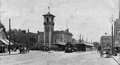 |
Brookline Village, circa 1910
Washington St., looking west toward Boylston St. From left to right:
- [108 Washington St.] a partial view of Frank Fine, florist
- [34 Walnut St.] J. Edward Kirker, Real Estate (sign on roof)
- [38 Walnut St.] Marks Bergstein, tailor
- [40 Walnut St.] Eagle Hand Laundry
- [Walnut & High] the Union Building which housed the Brookline Friendly Society
- [140 Washington St.] New fire station completed in 1908 and still in use today
- Inbound trolley
- [#166 Washington St.] The Brookline Print sign visible on the Guild Block building
[Source: Joel Shield]
|
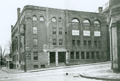 |
Union Building, Walnut and High Streets
The Union Building, a massive stone structure located at the corner of High and Walnut streets, was erected by the Brookline Friendly Union, a group formed to improve the lives of the poor of Brookline. The building was to be the center for all the charitable activities in Brookline. There were rooms for club work, a hall for dramatic and musical entertainment, a coffee room, a gymnasium, a billiard room, a bowling alley, and a "conversation room in the basement for working men to congregate to discuss the affairs of the nation."
The building was razed in 1961 to make way for public housing as part of the Brookline Redevelopment Authority’s urban renewal project in the area known as The Farm.
[Source: Brookline Preservation Department]
|
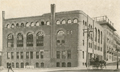 |
Union Building, Walnut and High Streets
The Union Building, a massive stone structure located at the corner of High and Walnut streets, was erected by the Brookline Friendly Union, a group formed to improve the lives of the poor of Brookline. The building was to be the center for all the charitable activities in Brookline. There were rooms for club work, a hall for dramatic and musical entertainment, a coffee room, a gymnasium, a billiard room, a bowling alley, and a "conversation room in the basement for working men to congregate to discuss the affairs of the nation."
The building was razed in 1961 to make way for public housing as part of the Brookline Redevelopment Authority’s urban renewal project in the area known as The Farm.
[Source: Brookline Preservation Department]
|
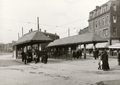 |
Village Transfer Station, circa 1911
On Lower Washington St., recently completed in September, 1909. On the left is Boylston St. looking west. The grocery store of Thomas F. McMahon is visible behind the left platform. The Sagamore Café, which closed in April 1912, and the drug store of T. E. Burns are visible behind the second station.
[Source: MBTA]
|
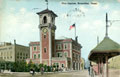 |
Station A (Now Station 1), Brookline Village, 1912
Bushes are larger.
|
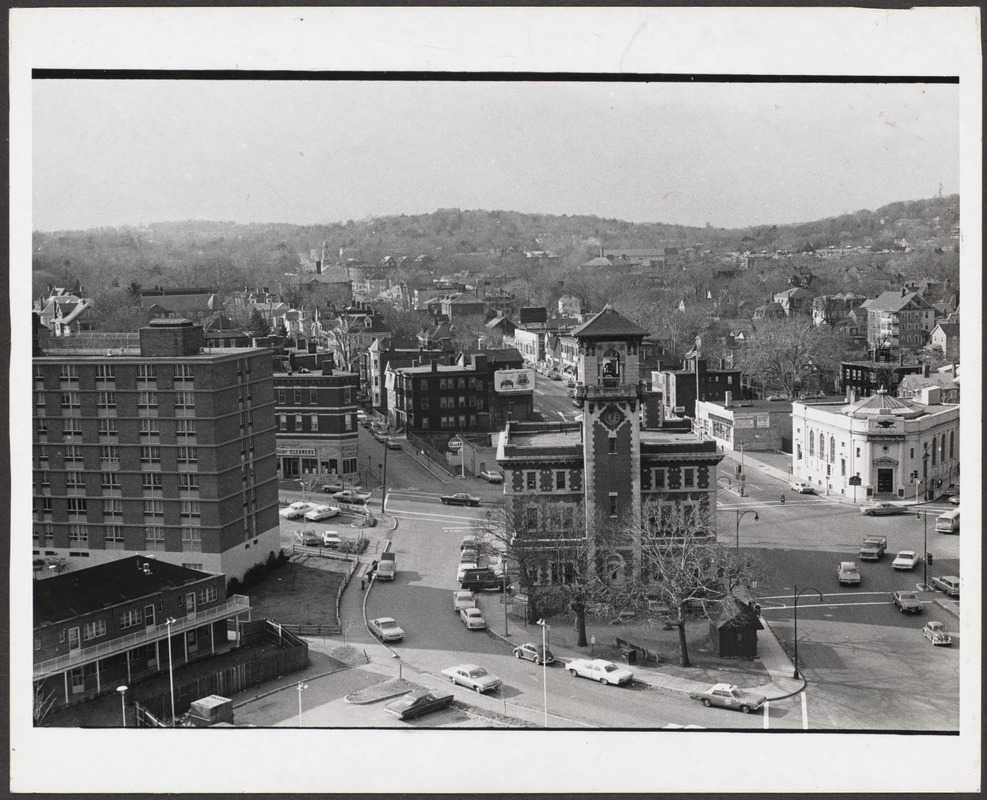 |
Village Square
[Source: Digital Commonwealth]
|
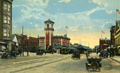 |
Brookline Village, 1920
Looking west on Washington St. toward the start of Boylston St.
Village Square, where Washington Street met today's Route 9, was the commercial center of Brookline from the 1840s until after the Civil War. Most of its commercial and residential buildings were replaced by office buildings during the urban renewal of the 1960s. Pictured here are the still existant 1908 fire station and the transfer stations of the Boston Elevated Railway. The rail route was replaced by a bus line in the 1930s, and the rails were removed for scrap steel during World War II.
|
|
 The Society
 Program Archives