 |
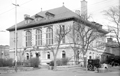
Police Station, Jan 31, 1919
(ID) 145
(Slide ID) P-23-14
[Source: William Robert Murphy Collection]
|
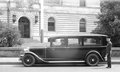 |
Police Ambulance, 1930
(ID) 162
(Slide ID) P-98-5
[Source: William Robert Murphy Collection]
|
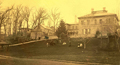 |
PD Unidentified #001
[Source: Brookline Preservation Department]
|
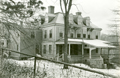 |
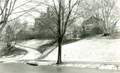
PD Unidentified #002
In a folder labeled "Sewall Ave."
[Source: Brookline Preservation Department]
|
 |
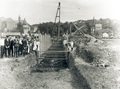
PD Unidentified #003
In a folder labeled "Sewall Ave."
[Source: Brookline Preservation Department]
|
 |
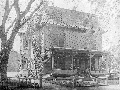
Aspinwall Brook and Sewer Project, 1878
Looking southeast at Boston just east of today’s Aspinwall Park. In the distance on the left is the west side of the Boston’s House of the Good Shepherd on Huntington Ave. and on the right is Boston’s Parker Hill.
This is most likely work on the “Aspinwall Brook” or the new sewer line being put in next to it.
[Source: Brookline Preservation Department]
|
 |
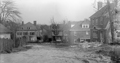
PD Unidentified #007
[Source: Brookline Preservation Department]
|
 |
Unidentified, April 30, 1927
Possibly in the Aspinwall Hill area
(ID) 124
(Slide ID) P-9-22
[Source: William Robert Murphy Collection]
|
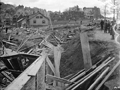 |
1501 Beacon St.
Standing on the south side of Beacon St. looking west. The apartment building at 108-116 Winthrop Rd. is in the upper left corner. In the distance on the right is the six-story apartment building at 1569-1571 Beacon St., still standing. In the foreground is the future location of Brandon Hall at 1501 Beacon St. The pile of debris is unexplained as there was no structure there previously.
(ID) 158
(Slide ID) P-1-4
[Source: William Robert Murphy Collection]
|
 |
University Rd.
Looking west from #63 on the left
[Source: Brookline Preservation Department]
|
 |
43 Upland Rd.
[Source: Brookline Preservation Department]
|
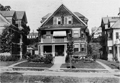 |
33 Bartlett Crescent
[Source: Joel Shield]
|
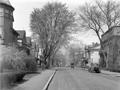 |
Waverly St., April 18, 1931
(ID) 064
(Slide ID) P 106-H
[Source: William Robert Murphy Collection]
|
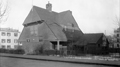 |
Parsons School, Walter Ave.
This is the only known photo of the school.
(ID) 117
(Slide ID) ?
[Source: William Robert Murphy Collection]
|
 |
157 Walnut St.
Standing on the property of 6 Irving St. looking north across Walnut St. A house at 6 Irving St. was later built in 1948.
[Source: Brookline Preservation Department]
|
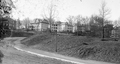 |
University Rd., 1912
Standing at the eastern end of University Rd. and Washington St. Looking at the rear of houses on Winthrop Rd. Construction of houses on University Rd. has not yet begun.
(ID) 157
(Slide ID) P-27-28
[Source: William Robert Murphy Collection]
|
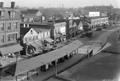 |
Lower Washington St., December 18, 1931
(ID) 015
(Slide ID) P-115-18
[Source: William Robert Murphy Collection]
|
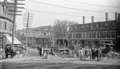 |
Relocation of the Village Brook, 1893
The work on the tunnel was completely in early 1894. Lower Washington St. going toward Boston is to the left. Note that this is one of two different views taken at the same time.
On the north side of Washington St. on the left:
- Unidentified delivery wagon labeled “B. Bancroft”
- 145 Washington St., awning of Thomas S. Brown & Co., provisions
On the south side of Washington St., from left to right:
- Trolley car on the Cypress St. line
- 106 Washington St., house of Jeremy Guilfoyle with a wagon out front
- 110 Washington St., H. G. Jordan, Coal and Wood, the office and also a sign above the alleyway leading to their coal yard at the corner with Morss Ave.
- 126 Washington St., William Frawley, custom shoemaker (note picture of boot on sign
- 126 Washington St., Luigi Barba (aka Louis Barbour and Louis Barber), fruit
- 128 Washington St., Frank T. Fay, newsdealer, cigars and tobacco
- 134 Washington St., John Barthelmes, hairdresser
- 136 Washington St., Sing Lee, laundry
Tom Condon, Sr. Civil Engineer for Brookline writes:
The work shown is part of the relocation of the outlet of the Village Brook. …(in the pile of lumber in the background you can see a piece of the curved falsework used
to hold the brick arch until the cement mortar set.). Leverett Pond was created from the Muddy River marsh located just south of Washington Street by installing a stop plank manhole (in effect an adjustable height dam) in the new culvert under Washington Street. This stop plank manhole was necessary to hold back the pond since the Charles and therefore the Muddy Rivers were still tidal at that time. Presumably, Alexis French (who was both Olmsted's engineer and the Town Engineer) determined that more flow into this new pond was necessary. To provide this additional flow, the Village Brook which flows alongside what is now the MBTA "D" line was diverted into the culvert shown under construction. The culvert runs east down Washington Street, crosses Walnut Street, runs down Morss Avenue (now discontinued), across Pond Avenue and into Leverett Pond.
(ID) 013
(Slide ID) P-13-13
(Notes) Replaces existing image
[Source: William Robert Murphy Collection]
|
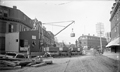 |
Relocation of the Village Brook, 1893
Looking west on Lower Washington St. toward Boylston St.
(ID) 014
(Slide ID) P-13-18
[Source: William Robert Murphy Collection]
|
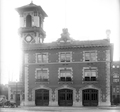 |
Fire Station A (Now Station 1)
(ID) 035
(Slide ID) P 23-14
[Source: William Robert Murphy Collection]
|

 The Society
 Program Archives