|
The Society
Historical Information
Photo & Map Collections
Exploring Brookline
Links
Program Archives
|
Lantern Slides
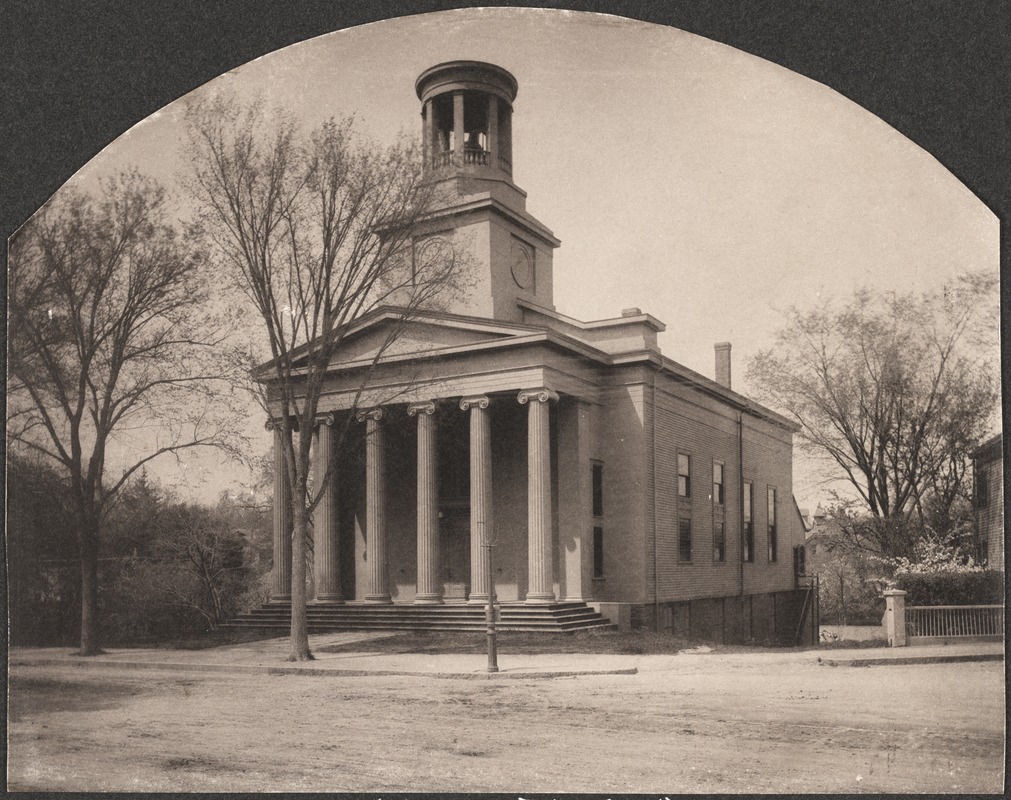 |
Harvard Congregational Church, Corner School St. and Washington St.
Washington St. runs left to lower right, School St. enters on the right.
Known as the “Bethany Building”, the church was constructed in 1844 as the first church in Brookline of the newly-organized Harvard Congregational Society. The building was sold in 1873 as the Society prepared to move to a larger structure at the corner of Harvard St. and Marion St. After a brief stint as a Methodist church followed by several additional changes of ownership, the building was acquired in 1887 by the Bethany Sunday School Association which held it for the next twenty years. The building was torn down in 1928.
|
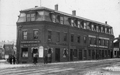 |
Brookline Village, Guild Block Building, circa 1903
Boylston St. looking west to the left; Washington St. on the right. Pictured from left to right:
[#164 Washington St.] On the corner of the Guild Block building, the faded sign of the previous owner of the grocery store, Francis H. Bacon, is still visible to the right. Thomas F. McMahon, who had been a clerk in Bacon’s store, took over the business when Bacon died in 1898.
[#172 Washington St.] Henderson Dairy and T. A. Conroy, Gas and Electric Fixtures.
[#174 Washington St.] Horace James, Mason
[#176 Washington St.] George P. Johnson Fish Co.
[#178 Washington St.] W. H. Pazolt, Sign and Carriage Painting; and F. H. McMahan, Plumber
|
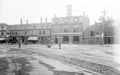 |
Lower Washington St., Brookline Village, circa 1905
The businesses viewed here, along the south side of Lower Washington St., were simultaneously sited at this location from 1904 - 1906. All the structures in this photo were demolished in 1907-1908 to make way for the new fire station which opened in 1909 and remains in use today. Note the man with his wheeled bucket, center photo, presumably scooping up horse droppings. Viewed from left to right:
- The business with the partial view of an awning is at the corner with Walnut St., the last building in this row. The best estimation is that it is the store of James Heleotis and John Sigalos Co., fruit [1904-1906]. The awning appears to advertise "Ice Cream Sodas" mirroring the sign at the corner entranceway visible in other photos.
- An enigmatic sign over the alleyway that seems to advertise a shooting gallery. This is currently unidentified.
- By the delivery wagon at #126 Washington St. are William Frawley, shoemaker [1889-1907]; and a bootblack, either W. L. Jacklin [1904] or Cromwell Felton [1905-1907].
- C. E. Riley, Cigars at #128 Washington St. [1900-1907]
- The awning at 134 Washington St. George W. Rix, Provisions and Transfer Market [1904-1907]
- Sing Lee, laundry, which was at #136 Washington St. for over 20 years [1883-1907]
- Hose Company No. 1, Chemical Engine No. 1 at #140 Washington St.
- P. J. Burns, Horse Shoe Forge at #144 Washington St. [1897-1907]
- Also at 144 Washington St. there remains a sign for R. Woodward who had a horse-shoeing business there from the 1860s until his death in 1892
- J. H. Pineo, carpenter and builder at 4 High St. (visible at corner of Washington St) [1901-1907]
|
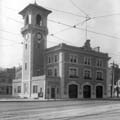 |
Station A (Now Station 1), Brookline Village, 1909
|
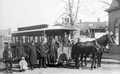 |
Brookline Village. Horsecar at Morss Ave & Walnut St. Stable, 1893
This is the last remaining horsecar in Brookline. Service began in 1859 and will soon switch to electric. On the right is the corner of the car house at #2 Walnut St. The entrance to Morss Ave. is just to the left of that. #97 Washington St. is viewed left in the rear.
|
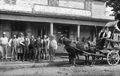 |
Lower Washington St. At Entrance to Walnut St.
Brookline House, 108 Washington St., an eating establishment and boarding house started by Aaron Whitney circa 1865 and closed circa 1874. Comstock, Gove & Co. is making a delivery. A Boston firm, they bottled soda water and eventually expanded to making liquor.
|
 |
Oliver Whyte House, Walnut & High, circa 1860s
Located behind the Village Square fire station on the southeast corner of High St. and Walnut St. With the death of his widow the house was torn down in 1871. Note the two women on the stoop of the house.
|
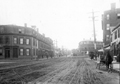 |
Brookline Village, circa 1899
Looking West on Washington St. toward the link with Boylston St. Walnut St. is off photo left foreground. This is one of two photos taken from slightly different positions. From left to right:
- The left side of the apartment building at the entrance to Walnut St. is a rooming house.
- The right side of the apartment building will be converted in early 1900 to a store front.
- #164 Washington St., corner of the Guild Building: Thomas H. McMahon, Grocer
- Washington St. curving north
- #129 Washington St., the four-story brick building: Jacob Morlock, Bakery/Restaurant
- #121 Washington St.: William F. Young, Grocer. Note the cat out front by the curb.
- #115/117 Washington St.: M. Cavicchi, Fruits, Nuts, Figs. Note what appear to be small Christmas trees stacked outside.
[Source: Brookline Preservation Department]
|
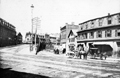 |
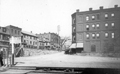
Brookline Village, Washington St.
Looking north on Washington St. Only one side of Washington St. has a bridge over the railroad tracks. The small road to the right is essentially another lane of Washington St. with additional access under the bridge to White Place. In 1888, the bridge would be extended across both lanes.
|
 |
Brookline Village, Station St.
Looking north on Washington St.; brick building in foreground exists today. The building was raised significantly to match the height of the bridge before Station St. was added.
|
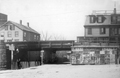 |
Brookline Village Train Station, circa 1885
At Station St., looking west under the Washington St. bridge. Only entrance to White Place.
Tom Condon, Sr. Civil Engineer for Brookline writes:
It would be interesting to note that the roadway passing under the bridge to the right of the railroad was the only access to White Place at the time since it was a dead end street. When the bridge was later widened, it was also shortened so as to only cross the railroad tracks. The end of White Place was filled in to meet the grade of the new bridge. That is the reason for the retaining wall between White Place and the "D" line which is located about where the center support of the bridge is.
|
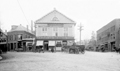 |
Harvard Square, Brookline Village, circa 1901
Washington St. continuing to the left, Harvard St. to the right. The Panter's Building has been sold and renamed to the Harvard Hall building. From left to right:
- Post Office
- 279 Washington St., the store of Nelson C. Thompson who took over the furniture and upholstery business from his father.
- The stores of Thomas H. Dyer, grocer, and Frank F. Seamens, Groceries. Both would remain until 1904 when the building was being prepped for replacement with the building that stands today. Dyer would hang on into 1905 in the building’s reduced and dilapidated state, as litigation was resolved.
- The E. S. Morse making deliveries of what is likely coal. The horses are drinking at the fountain.
- National Bank building at 1-5 Harvard St., still standing.
|
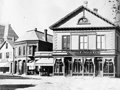 |
Panter's Building; Brookline Village, circa 1876
Looking North from Washington St. Panter's Building was a remodeling of the old Baptist church building at that site. It was obtained by John Panter as payment for his work on the replacement church, seen behind it, and converted into a commerical building. He later sold it to George Joyce who moved his grocery store from the Colonnade Building circa 1874.
[Source: Brookline Public Library]
|
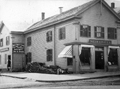 |
Brookline Village, Northwest Corner, Washington St. & Davis Ave.
Washington St. going north to the right; Davis on the left. The second floor was used by dancing and singing schools. Replaced by the brick Seamans building in 1889.
|
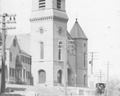 |
Baptist Church, Harvard St., 1897
Western side of Harvard St. just north of fork with Washington St. Church is at the corner of Pierce St. #14 Harvard St. just visible to the left.
|
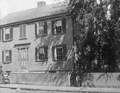 |
Old Dana House
Washington St, near Cypress St. and soldier's monument. Note: there are three people in the photo.
|
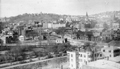 |
Lower Washington St. at the Boston Line, circa 1909
View From Parker Hill. Brookline Hills in the background. At the extreme left in the center of the photo are the two matching apartment buildings that are located at 165 Pond Ave. (front) and 19 Villa Lane (rear). The large black gasometer tank of the Boston Consolidated Gas Co. is in the middle left and the small white house in front of it is located at 19 Villa Lane.
|
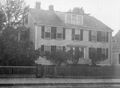 |
Tolman House, on the site of the current VFW/American Legion Hall at 384 Washington Street
In the 1820s the house was the location of a school run by the sisters Elizabeth and Mary Peabody.
|
 |
43 Linden St.
Looking west toward Harvard St. The estate of Harrison Fay is on the left, no longer standing.
|
 |
Thomas Aspinwall Davis House, Linden Park.
Originally overlooking Linden Park from today’s Linden Court, the house was rotated clockwise ninety degrees circa 1905 to its current location of 29 Linden Place.
|
|

 The Society
 Program Archives